Directed by Robin Hardy. Written by Anthony Shaffer.
A policeman arrives on a remote island off the coast of Scotland to investigate the disappearance of a young girl. We watch him arrive by small plane, gliding over cliffs jutting out of the water before he zips over lush green fields and a cottage village. Postcard stuff. Yet, the island doesn’t get a lot of visitors, that much is clear, as the entirety of the small community is rubbernecking out their windows to catch a glimpse of the newcomer.
Despite their curiosity, the investigator, Sergeant Howie, has a hard time getting a word out of the locals. First they deny the missing girl’s existence, then they question the meaning of the word “existence” and soon Howie ceases to give them the benefit of the doubt and continues his investigation without them. Disturbing as their obstruction of justice is, Howie, a staunchly religious man, is more upended by this community’s paganism.
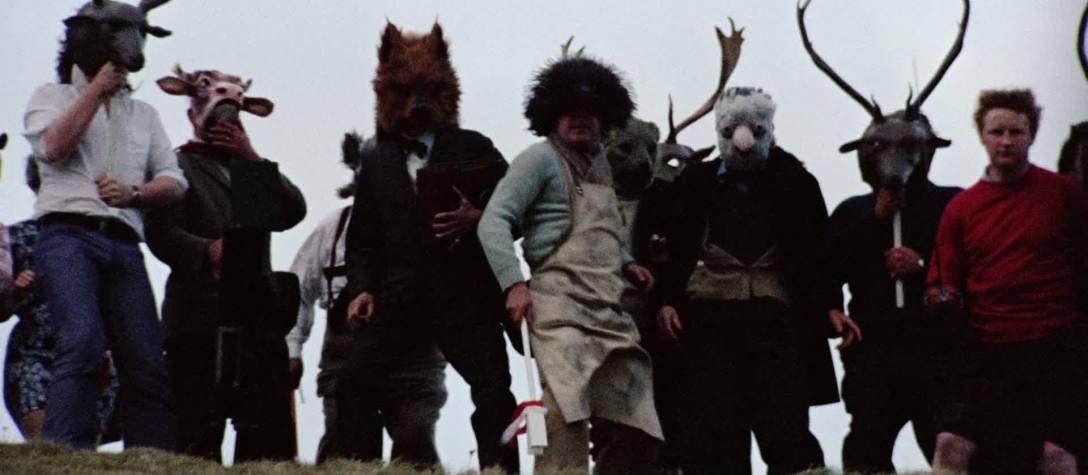
He happens upon orgy scenes taking place out in the open, a naked woman weeps by a grave, other naked women leap over a bonfire in the hopes it’ll make them fruitful; they’ve left churchyards crumble, and perhaps worst of all, there’s not a single minister on the entire godforsaken island! At times, you feel Howie’s true dilemma is whether to call in for backup or an exorcist. The concerns dovetail however, as he becomes convinced the girl’s fate and these pagan beliefs (and their rituals) are connected.
The Wicker Man is audacious and quintessential folk horror, providing the broad shoulders that films like Midsommar stand on. It’d take many moons to list what The Wicker Man does right, but its power lies in how it perversifies some of society’s virtues, like the sense of community, the culture fostered within it, and the bonds it builds among its members. The residents of Summerisle are by all accounts good people. They know each other by name, and their children too. They lend an ear to concerns big and small. Their creed is one based on inclusion and service to others. Hardy shows us the horrifying use that sense of community can be put to.
Combine this with the deep-seated unease we can feel as outsiders to a close-knit community, and you have fertile grounds for terror as Howie comes up against something he’s completely at odds with and unable to penetrate. We all fear what we don’t understand, and there’s no better example of that than Howie, an exaggerated proxy of us all as we watch the townspeople. As Howie, Edward Woodward tries to keep the eyes from rolling right out of his head in disbelief as he comes across one upsetting thing after another. When life as we know it is lived at such a slant as it is on Summerisle, who knows what else they’re capable of?
Finding out is a thrill, though. Writer Shaffer creates a fully realized civilization with its own lore and Hardy’s direction in setting up the eerie amicability of the island’s inhabitants gives everything a surreal edge. Beyond disturbing, The Wicker Man is also delightfully weird with its gallery of peculiar characters who only appear more so in comparison to Woodward’s buttoned-up policeman.
As their enigmatic leader, Christopher Lee stars as Lord Summerisle, and for people only familiar with Lee as a dour and imposing figure, Lord Summerisle is a clean break as a jovial, inviting host who lounges in a kilt, unwinds by belting out chamber tunes in his rich baritone voice, and regales Howie with explanations of why life is the way it is on Summerisle. Howie’s apoplectic response is almost reason enough to watch The Wicker Man.
Finally, a soundtrack by Paul Giovanni and Magnet is spectacular and features a long list of folk songs embedded directly into the story as genuine storytelling tools, making The Wicker Man the rare folk horror-musical hybrid. With the rich history of Scottish folk music to lean on, the decision feels obvious in hindsight.
Enigmatic, quirky, charming, evocative, unsettling and ultimately upsetting, The Wicker Man deserves its accolades and esteem. Summerisle is a place both compelling and repugnant, and that’s to Hardy’s credit. For 90 minutes, it’s definitely worth a visit.
 Mikkel Frederiksen