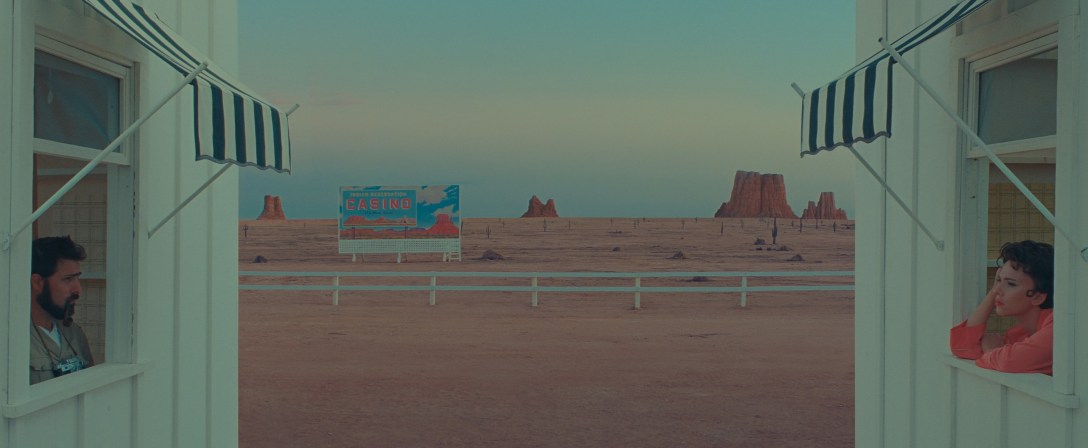
Directed by Wes Anderson. Written by Roman Coppola and Wes Anderson.
In the astronomical scale of things, nothing we do really matters. Planet Earth could be wiped out by a devastating event, and as distressing the experience would be for all us, the universe wouldn’t even sense it. Less than a bug on the galactic windscreen as time hurdles along on the cosmic highway.
The intrusive realization that we aren’t alone in space and not all that unique can have revelatory effects. We’re suddenly less special, our issues less impenetrable once our besieged inner life is overshadowed by an external presence, and the glare of the new world order puts life into relief. That’s exactly what happens in Wes Anderson’s Asteroid City, as a gathering of space nerds, their parents, and incidental attendees is interrupted by an extraterrestrial outsider.
Life’s meaning, grief and relationships are pondered in the resulting dust-up, and it makes Anderson’s latest a heartfelt affair. Augie Steenbeck (Jason Schwartzman) is taking his son and three daughters to his father-in-law’s place after the death of his wife and children’s mother. The grief is too much to bear right now, and he even struggles to articulate it to his kids. They of course find out, and try to make sense of it in their own way.
Midge Campbell (Scarlett Johansson), a famous actress, has rolled into town with her daughter, one of several from multiple marriages. They’re a little estranged, and Midge knows it’s her fault. Later, Augie’s father-in-law (Tom Hanks) shows up, a foppish man, and there’s little love between these two men. All in all, plenty of people and plenty of baggage in this makeshift town in the middle of the Nevada desert that is home to little more than a few cabins, a garage, a government lab, and a big crater wherein an asteroid landed long ago and gave the city its name.
This close-proximity setting almost makes it a potboiler with all these hefty emotions, but the narrative framing gives us an opportunity to keep it all at arm’s length. The entire movie’s setting and characters is introduced first as a theater production, with the play’s writer introducing characters and the setting in droning detail. A somber black-and-white introduction to a vivid story of pastel colors. As the story goes along, scenes from the real life of the actors portraying the characters are inserted like footnotes.
These insertions are like a meta-treatment of the same topics, however, as questions of meaning, aptitude and purpose bleeds right off the screen and into real life. The coincidental nature of casting, creative choices, and cut parts translate directly into the unpredictability of life experienced by the temporary inhabitants of Asteroid City. Life imitates art, imitates life again.
Some of Anderson’s films are like pop-up picture books, ornate creations and intricately designed. Sometimes his stories work like advent calendar gates where one opens to reveal an equally intricate universe. Asteroid City weds to the two and sees ambitious narrative framing coupled with Anderson now-trademarked visual flair. Every object, and there are many, offers avenues for interpretation, and that’s fun on its own, but we’re also treated to some poignant musings on deeply human subjects. The result is something rewarding, moving, and uplifting.
Asteroid City is brimming with life, including teen romance, adult existentialism, parental commiserating, and familial reconciliation, and it’s something that was missing from his latest The French Dispatch. City sweeps you along like a steaming train, cuts you down with some of its speeches, and stuns you with set pieces.
Thinking about how small we are in the universe, in life, can get you down. Coincidences can permanently alter our lives, and life’s frailty can make it feel trivial. Anderson’s here to say that’s only one way to look at it. A beautiful monologue can be cut from a performance and never get to be heard, but that doesn’t make it any less beautiful. It did exist, and that’s enough. You can question yourself, like Augie’s actor does, asking “am I doing it right?” when you should simply be thankful you’re here to do it and think not of its supposed importance, what it means, or where it’s supposed to take you. Just let it, and stick with it.
 Mikkel Frederiksen