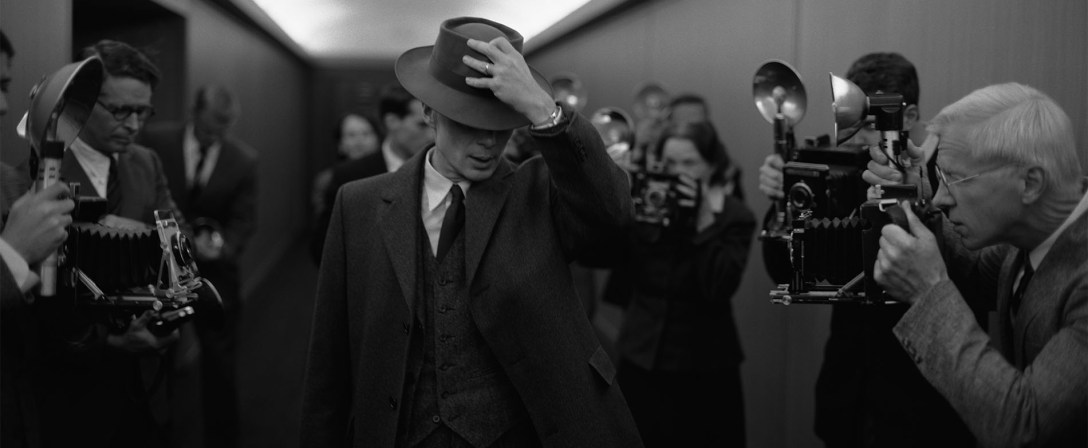
Written and directed by Christopher Nolan
Is it jingoism if it’s wearing a lab coat? Is it genocide if you don’t press the big red button yourself? Was Robert J. Oppenheimer, the father of the atomic bomb, a monster whose work gave mankind the ability to destroy itself, or was he one the finest minds of his generation who stood up for his country and did what was asked of him in the fight against an obvious evil?
Over the three-hour runtime of Oppenheimer, Nolan looks to give the full measure of the man who was a scientist first, then became a politician, and ended up a polarizing cipher in the popular imagination and a target of petty politics. Did he get what he wanted? Or did he get what he deserved?
To answer that question, we get a profile of this man with all the angles. In the guise of Cillian Murphy, we observe him as a scientist, a colleague, a husband, a “patriot” (whatever that might mean), and as a character of history. It means it’s a talkier Nolan film compared to the rest, but fear not, this is not slow and dutiful documentary filmmaking.
Oppenheimer first details the collaborative discovery of the knowledge that enabled the bomb before it settles in the desert for the arms race, and despite the mushroom-shaped shadow that hangs over Oppenheimer and his colleagues’ work, you can’t help but get swept up by the thrill of scientific pursuit as Nolan lets ambition and ability take center stage. Brilliant minds giving carte blanche to apply their considerable genius – it’s hard not to root for the undertaking, even against your better judgment.
After his “triumph” (Nolan is quick to suggest Oppenheimer’s misgivings about what he’s put into the world), we learn of the cost. His home life’s not a parade, and as the atomic dust settles, Nolan’s real endgame emerges, one which isn’t concerned with what kind of world Oppenheimer brought us into, but rather what the world will think of Oppenheimer. The real struggle becomes the political menagerie he became embroiled in after being crowned science’s homme du jour as his leftist leanings come to light in Joseph McCarthy’s Red Scare America.
All is expertly woven together by Nolan, so when the time comes for the political undressing, we’ve already seen how Oppenheimer has made his bed, be it the petty rivalries with peers, the strained marriage (IQ ≠ EQ), and the (many) infidelities. For scale: a year-long affair is only referenced in passing because other affairs dwarf it, so prolific is his skirt-chasing. As salacious as some of it might be, the dry, personal interrogation is the meat and matter of Nolan’s film, more so than the flash and fire any marketing campaigns might have sold you.
In its entirety, Oppenheimer is a gripping movie about a deeply flawed but brilliant man, and Nolan is the right director to maximize the experience of the movie’s central occasion. He even stretches his artistic sensibilities a bit and you can witness what’s as close to abstract experimentalism as Nolan is likely to ever get. Some hallucinatory shots add some mysticism to his otherwise methodical filmmaking approach, and it looks good on him, even if these instances feel like cinematic baby steps in how obvious their application is.
Nolan shows he is still one of cinema’s grand masters of spectacle, but it’s also another showcase for the type of protagonist that can be said to be Nolan’s favorite. I’m referring to those men who straddle the world and put all other considerations aside in achieving their goals. I’m talking about Batman, a billionaire vigilante, or the Protagonist of Tenet, a rogue agent who’ll stop at nothing to save the world, or the two magicians of The Prestige, whose bitter hunger to outdo the other pushed them far beyond the pale.
In these films, Nolan only offers feeble moral checks and balances to a mostly celebratory depiction of men who harness great power, and while these shortcomings are not damning in fiction blockbusters, with Robert Oppenheimer, Nolan suddenly got a live one whose real-life exploits enabled monstrous death on demand. I’m not asking for moral judgment, since that’s not the job of art, but Oppenheimer aspires to be an intense character study above all else, so it’s not unreasonable to expect something more involved than a History Channel-esque completionist tale that spends a lot of oxygen on the bureaucratic shenanigans that apparently did more to define Oppenheimer’s than the one accomplishment that everyone knows him for.
Oppenheimer is exciting, despite much of it taking place in thrilling locales such as science labs and drab conference rooms, but there was potential for a much more inquisitive and evocative exploration of this man who ushered in the Nuclear Age. A portrait film that never takes its gloves off as it studies this man whose big ideas had catastrophic consequences. Oppenheimer would have been served well by some big ideas of its own.
 Mikkel Frederiksen