Directed by Stanley Kwan. Written by Kang-Chien Chiu and Pik-Wah Lee.
Romance can be bewitching. It can transform the world and how you look at it, but when its feelings are dashed, it lays waste to everything. Inside the heady courtship of Rouge you find this hard truth, and its implications are disheartening. Everything gets worse over time, nothing good is truly as it seems, and what you thought you had, you may never have had at all.
In the story of Fleur and Chan Chen-Pang, these cruel lessons revolve around an intense love affair in 1930s Hong Kong. She’s a courtesan, revered; he’s a young business man, admired. His courtship is insistent, and the initial distance is quickly closed to intimacy. His family doesn’t approve of their union, however, making a happy forever after impossible. At least in this life…
Fifty years later, newspaperman Yuen-Ting (Alex Man) has a woman show up at his work, looking to publish a personal ad. She’s looking for the man who was supposed to join her in the afterlife, but never came. Preserved as she was back then, a ghostly Fleur now moves through a vastly different Hong Kong trying to find out what happened. Together with his reporter girlfriend Ah Chor (Emily Chu), Yuen-Ting lends a hand in trying to unite these star-crossed lovers.
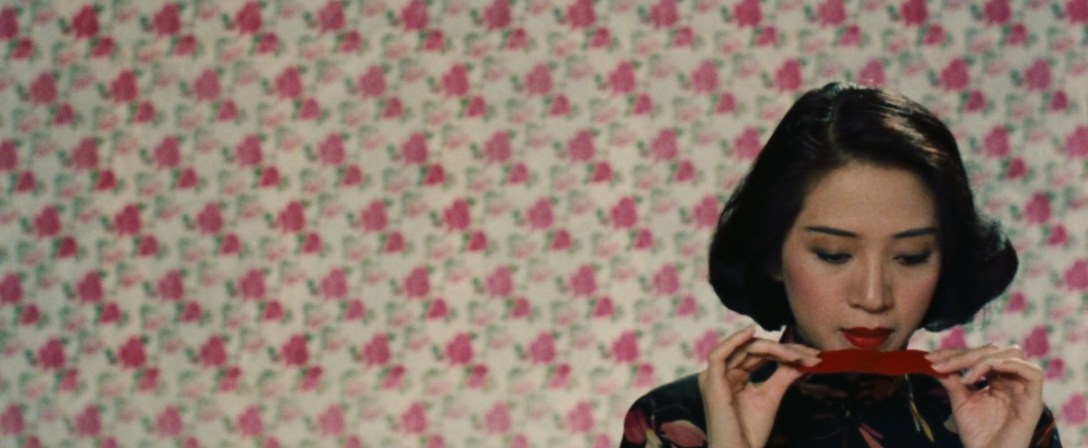
You get why all parties would like this lover’s mystery resolved. The way Kwan shoots it, the heyday of 1930’s Hong Kong is so lush, and his direction so sensuous that you’re getting a little wooed too. Anita Mui is spellbinding as Fleur, and Kwan’s direction is under her spell, as his lens flutters around her and glides from side to side as if it’s performing some exotic bird’s mating ritual. It’s as enchanting as the opium both Fleur and her lover enjoy.
With all this rose-scented perfume shrouding you, the sour realities hit all the harder as Rouge slowly makes them plain with a split narrative taking place in both the 80s and 30s that dovetail to devastating effect. Knowing just enough of a coming tragedy builds tension, and Rouge dances on this tightrope. When you think you’ve made it across, Kwan cuts the cord.
It’s not only lovers who are stretched thin by time, however as Kwan’s makes points about current-day Hong Kong. The deep and vivid colors of 1930 become drab concrete-gray amidst the high-rises of 1980. Neon ads look garish overhead. Fleur’s traditional dress draws looks and bemusement, and her smoldering looks are interpreted as leering by a generation raised on modesty and ironic distance to all sentiment.
Kwan doesn’t look to lionize the 30s, either. The courtesan culture and the gilded cages people like Fleur lived in are not celebrated, and the harsh societal hierarchy that seeks to keep Fleur and Chan apart is obviously intolerable, but in the vivid contrast of colors and community in then vs. now, something does appear lost.
Rouge feels a little torn between its central love plot and the societal commentary, and the present-day scenes don’t evoke much emotion until the thrilling conclusion, leaving you wanting for parts of the movie where Yuen-Ting and Chor’s modern-day reactions to Fleur’s life don’t draw much blood.
Social observation aside, Rouge is also built on a rather silly premise, and Kwan doesn’t work hard to keep it grounded. A spirit coming back for resolution since love won’t let it go on peacefully sounds awfully like Ghost, but thankfully Rouge has a different take, as the former sees an otherwise romantic premise devolve into weird action as Patrick Swayze looks after Demi Moore. Instead Rouge uses the frustrated presence of its central character to tell a story of the sinister mechanisms of society, relationships, and who gets hurt within them.
It’s like a bright, shiny bonbon that you pop in your mouth to initial delight, but the enjoyment ever so slowly fades until the candy’s sweetness turns to ash in your mouth.
 Mikkel Frederiksen