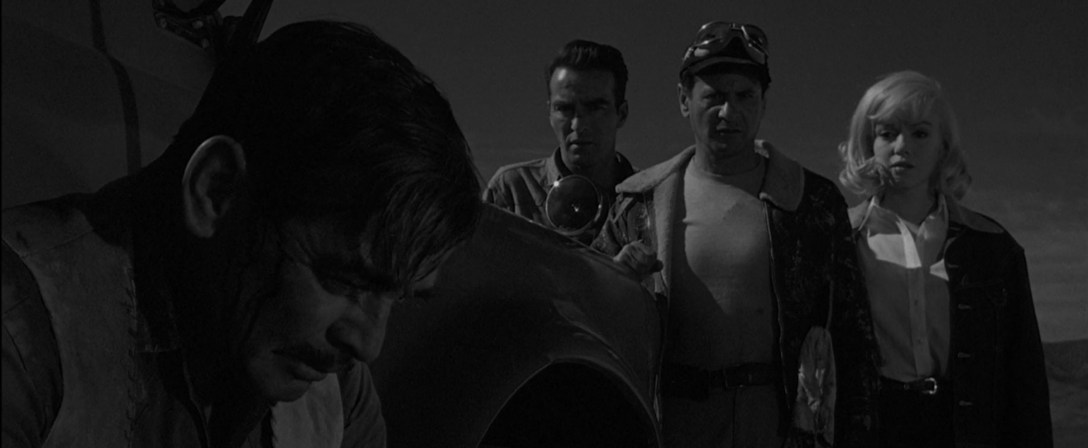
Directed by John Huston. Written by Arthur Miller.
If Las Vegas is America’s Playground, then the Reno of John Huston’s The Misfits are where its broken toys go. A city of players, charlatans and those running scared, its buildings might as well be tents as its citizens’ fear of commitment and cynical egocentrism make it a base camp for their dwindling prospects.
It’s fittingly a place where divorces are easy to come by. It’s why Roslyn Taber’s here, yet while getting divorced suggests at least one life lesson learned, Roslyn’s what can be described as a true innocent. She believes the best in people and cares for the unfortunate. In a city like this, she’s like an open flame for the hard-luck moths who project upon her redemption or seduction, and sometimes both.
Only person there to guide her is Isabelle Steers, stalwart Renonite who’s met just about every man there is (she’s been a witness to 76 divorces – Roslyn’s is lucky number 77!) but even she can’t quite keep Roslyn from taking up with an old-old cowboy by the name of Gay Langland. Together with Gay’s buddy Guido, the foursome make a weird little band of outsiders, and as they hunker down in a half-finished cottage out in the desert, they’re later joined by rodeo cowboy Perce.
All three men feel time catching up with them. Guido’s a widower, so there’s a wife-sized hole he feels Roslyn fits into. Perce’s rodeo days have taken their toll. His brain’s getting more scrambled with every tumble off the horse he takes, and he could use a soft place to land. Gay’s glory days are behind him, but he refuses to lose his freedom to roam the mountains catching wild horses for a living and sleep wherever he wants, with whoever he wants. To all three men, Roslyn is a life preserver.
Written by Arthur Miller, The Misfits is harsh existential fare full of those who time got away from. It’s like listening to the barflies tell of the last few “good” years before they ended up where they are, those last few years where they hadn’t realized the downward spiral had already begun. Clark Gable, Eli Wallach and Montgomery Clift are all exceptional as Gay, Guido and Perce, respectively, with Gable’s performance particularly poignant as it was to be his last.
Gable summons every ounce of virility still left in him to play Gay. Less dapper, but more raw as one of the last cowboys around who has the wear to show for it. When called upon, Gable sheds the hard shell to accurately portray an alcoholized stubborn man who would let no person come close to him in case there was a slightest chance it’d require him to not live completely by his own rules. It’s a bold curtain call for one of the first great leading men of Golden Age Hollywood.
Unfortunately, his character must also present a viable romantic interest to Marilyn Monroe who stars as Roslyn. There’s more than 20 years separating them, and those 20 years are hard on a man, so any suggestion of their companionship will make you squirm. He’s not smoldering here as he looks at Monroe. The twinkle in his eyes are merely them watering as he pleads for her consideration. Not very becoming of one of Hollywood’s elder statesmen.
For the most part of The Misfits, Monroe must also play a pastiche of herself. Director Huston makes Monroe a schoolgirl, asking her to deliver every sentence with an impish whisper as naïveté courses through her veins. Her character looks to get out from underneath the heel of her ex-husband, but the way her character stumbles into the harsh Reno sun, she’s more like a sheltered girl finally meeting something resembling real life. She’s more of an idea than a person with her startled innocence, some of which Huston might have done well to learn from, as he overtly sexualizes Monroe every chance he gets. More than just a gaze, she’s in the male grasp from the start.
The directorial leering does add to the sense that it’s a dirty, dirty, dirty world in The Misfits with many rough edges. Everyone in it has several cuts and bruises to show for it, and in a masterful third act, Miller and Huston do combine to deliver something close to a perfect climax of their ideas, where a confrontation in the desert distills in a few sequences the doomed struggle of a toxic masculine ideal that has been venerated in pop culture for going on 40 years at this point.
 Mikkel Frederiksen