Directed by John Carpenter. Written by Michael De Luca.
John Carpenter tests the limits of human comprehension with In The Mouth of Madness, the story of an insurance investigator’s slide down the rabbit hole in search of a best-selling author who’s gone missing.
Whether what we’re seeing is real, imagined or hallucinated is difficult to decipher, and the snake doesn’t take long to begin eating its own tail as John Trent (Sam Neill) alights on the small New England town that’s supposedly only a part of author Sutter Cane’s universe of cosmic horror. But here it is! Is Trent’s mind bending? Have the evil forces of Cane’s universe become real? Or were they always, and have only now begun to manifest themselves in the wider world through Sutter’s books? Who knows in this meta-fest of epic proportions.
Movies that seek to blur the lines of reality and throw its audiences for a loop usually make an effort at a sound structure and consistent inner logic as their part of the bargain. Otherwise, you risk yeeting your audience straight into the abyss of the incomprehensible without a life preserver. In The Mouth of Madness skids right off the rails, and while the confusion is total, it’s cheaply bought, since what unfolds was never anchored in anything we can trust. What parts are reality? Is any of it? It ultimately ceases to matter, for better or worse.
It means the whirlwind experience that Carpenter conjures with powerful filmmaking doesn’t take you anywhere, it just turns you around a handful of times. You have to be very down for the ride in the case of In The Mouth of Madness, because your sense of connection to proceedings fades fast. Its characters become 2D-dimensional in their passive victimhood or maybe-existence, and once you stop caring for the outcome, you might as well turn it off.
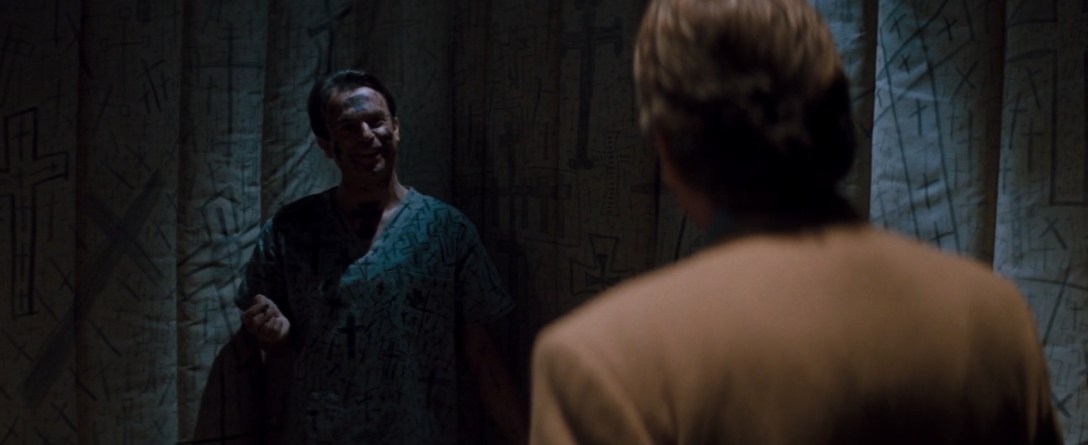
As our protagonist, Sam Neill feels miscast. Neill exudes capability and cunning while retaining an element of the everyman. As Trent, he must stretch the limits as a smarmy, arrogant ace investigator who must crack a few dorky jokes, and he snaps. He must also ham it up as a padded cell inhabitant, and that gleam of lunacy never materializes in Neill’s eyes.
John Carpenter’s out there with In The Mouth of Madness. A haunted house ride strapped to a rocket, it’s bewildering, and trying to keep up is like trying to wrap your hands around a greased-up spinning top. It’s an evocative piece of filmmaking, which is almost unfortunate, since it’d make it easier to dismiss the entire affair. There’s cosmic horror, more than a few jolts, and a deep sense of unease in the helplessness. But the blabbering of In The Mouth of Madness is too hard to ignore.
 Mikkel Frederiksen