Written and directed by Marguerite Duras
Wealth, infidelity, and back alley prostitution sounds like sordid entertainment, but in Duras’ hands, they’re rendered part of a minimalist trance-inducing act of hypnotism. A woman’s existential mire, Baxter, Vera Baxter, drags you down with it before it puts you under its spell… or simply just puts you under.
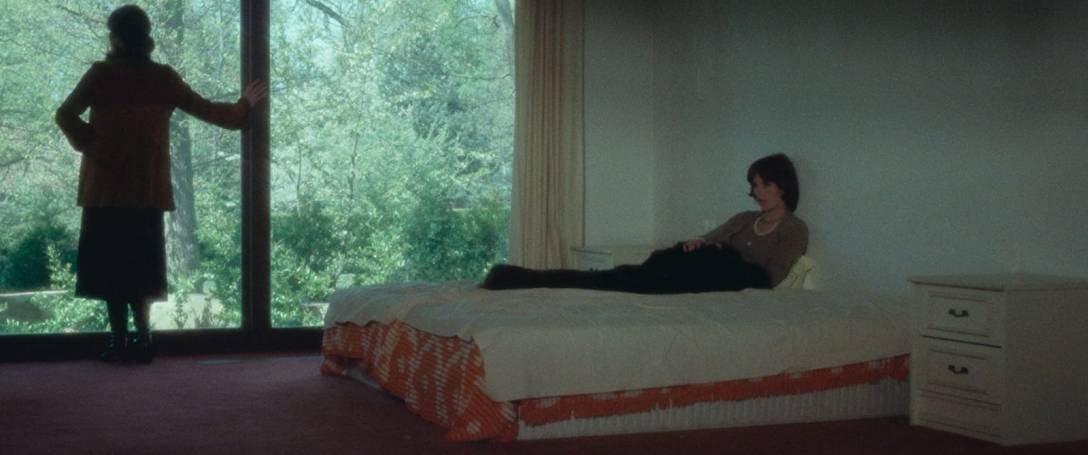
It’s a story of a woman wronged, and how her misfortune’s tied to her wife-, woman-, and personhood. It’s dense stuff and it’s unpacked, made convoluted once more, and finally unpacked again with disembodied interrogation and monologues. While you listen and try to take it in, you’re treated to something a few steps beyond CCTV as you watch Vera haunt an unfurnished mansion as a ghost of her circumstances.
It’s by simple means that Duras tells this story of a woman wronged and the mess of her life. Beyond the voiceover and simple visual sequences, a looping instrumental track featuring flutes, some slap percussion, and ukulele strumming lilts throughout. In the empty rooms of a postmodern house, its buoyant forest fairy energy grates against the morose energy of everything else. If anything, it feels like a mockery you’re trapped inside of.
The visual presentation of Baxter, Vera Baxter is one of distance, while everything else of great intimacy. It’s an insistent peek into one woman’s life and headspace, but Baxter, Vera Baxter won’t fight for your attention even as it requires it. Key points are delivered in uncaring monotone, devastating truths are admitted with the same cadence as if they were small disappointments. Who’s speaking and what they’re addressing isn’t always obvious, and the conversation shifts from one topic to the next without much warning.
There’s work to be done catching hold of Duras’ vision, and this mode of delivery is not for everyone. Every realization has the feel of a hallucination as you react to everything a moment after the sound of it fades. It’s not entertaining in the sense of immediate, distracting stimulation. It might not even feel entertaining, flat out.
It is art, however. Baxter, Vera Baxter packs in devastating and complex ideas and unpacks them with a spellbinding simplicity, its spartan presentation belying its poetic sensibility. There’s much to pore over and pick up on with repeating viewing, its stripped-back storytelling inviting you to explore the silences and visual gaps as much as what’s filled in. Vera’s going through something I hope few will experience first-hand, but the malaise, loneliness, and alienation is not uncommon ground.
Duras’ treatment of these feelings lies in the abstract, and the characters she’s mustered to embody them are obviously relatable. They exist somewhere deeper. You don’t nod hello to them on the street in recognition, but it’s in observing them, at a remove, you get a sense of what’s plaguing them. Baxter, Vera Baxter, with its observational lens and intrusive writing, accomplishes exactly that – if you let it.
 Mikkel Frederiksen