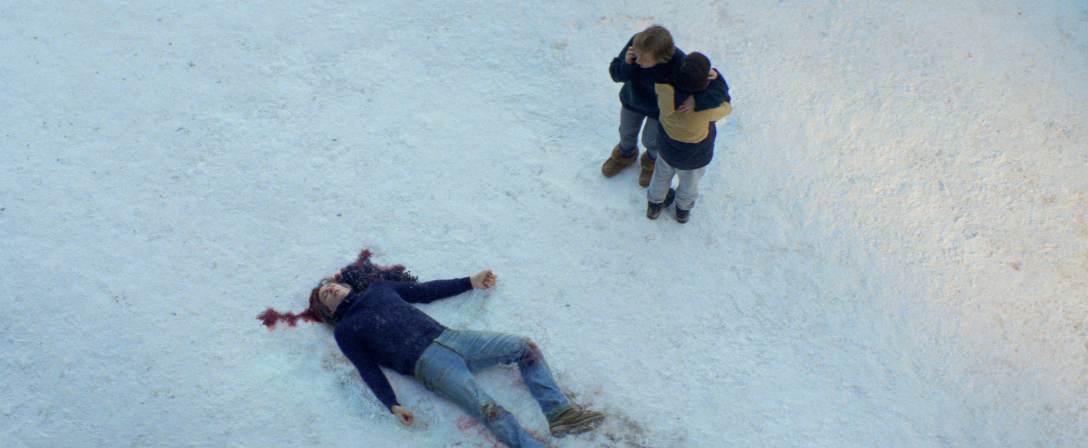
Directed by Justine Triet. Written by Justine Triet and Arthur Harari
How neat is your life? How organized, well-arranged and accounted for are your relationships with your loved ones? Would your life stand up to the agonizing scrutiny of a criminal court system where it’s poked, tugged at, ripped up at the seams and its parts presented out of context? What would your life look like then?
In the case of Sandra, not stellar. Her husband is found dead by their son, face down in the snow in front of their cottage with his head cracked open and eyes wide. She claims he must’ve fallen from two floors up, but forensics don’t bear her out. As the prosecution digs, they find conflict between the two: infidelity, internalized guilt over an accident that almost blinded their son, professional envy, and the simmering resentments that long-term relationships can accrue like barnacles. Murder is the charge.
Sandra’s freedom is at stake. More importantly, her relationship with her son. Even if she’s innocent, will there be a relationship once she’s had her life wrung out in front of his unknowing eyes? Sandra insists to her lawyer she’s innocent. He replies: that’s not what matters. Anatomy of a Fall, like an ever-accelerating steam train, shows just how true that is.
Justine Triet’s film is an ever-tightening vice, a stress-inducing story that adds chord after chord as it goes along, each one delectable. What starts as murder trial where you feel sure about the facts quickly becomes uneasy as director Triet, via the prosecution, shows everything’s not as it appears. This isn’t just to crack the movie open and turn it into a doubt-inducing brain scratcher, but to deepen it too, drawing out a cautionary tale of a complicated marriage. Finally, nestled like a pistil in the middle of movie’s petals, is a fraught relationship between mother and son.
It’s the density of it all that sees Anatomy of a Fall take a seat on your chest and squeeze you breathless, after which it lures out every primal emotion we possess and preys upon it. It’s one thing to be on trial for murder. You feel the fear of losing your freedom forever. It’s another to have to defend yourself in your (distant) third language, as Sandra’s French, after German and English, is far from fluent. You feel the alienation of an outsider. Seeing your persona get twisted in the court (and the court of public opinion) is frustrating, if not terrifying in how you’ll appear to your son, who’s watching it all and becoming privy to the adult secrets kept from him. You feel there’s suddenly an entire life at stake.
Add to that the simple, but impossible-to-answer question: are we rooting for a murderer?
Triet weaves this hell in a handbasket with poise, pace, and precision. An icy exploratory opening act gives way to a crucible of a second act. By the time the third rolls around, all bets are off, but Triet’s movie always feels right on track, totally in control. A damn tease, given how you’re in your seat looking for answers.
In the middle is Sandra Hüller’s sparkling performance as a mother, wife, public persona, and the accused. As Sandra, Hüller bares both her fangs and a soft belly, as a wife who can be cruel and domineering and a mother who is as kind and caring as the snow-melting sun. Hüller proves herself in the heat of confrontation as well as in a single, crowd-parting look.
Anatomy of a Fall, like its inspiration Anatomy of a Murder, explores the impossibility of knowing what’s in people’s hearts. Sandra says as much, saying a relationship is chaos, and anything plucked from the hurricane and presented as a standalone reality will come up painfully short. Collecting the pieces, and seeing how they fit together is a thrill in Triet’s movie, from certainty to nagging wonder. Distressing, frightening, funny, hellish, touching – all at once.
 Mikkel Frederiksen