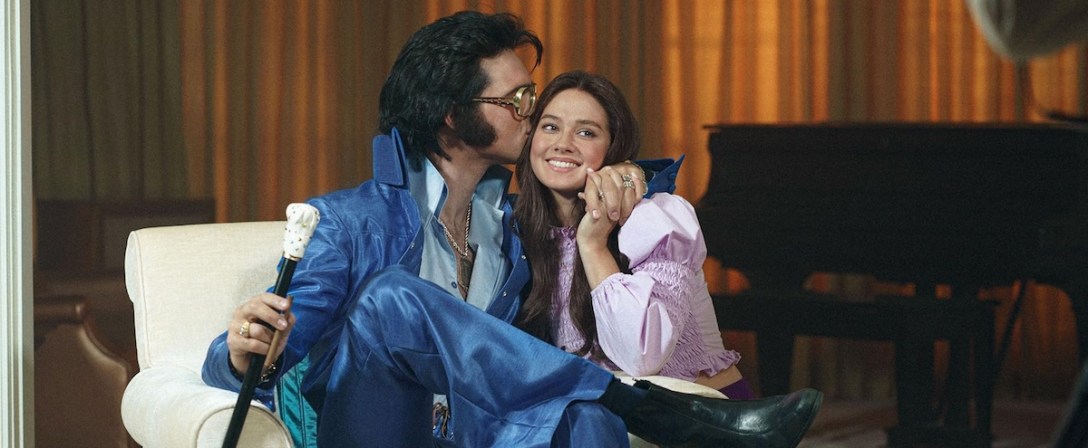
Written and directed by Sofia Coppola
Everyone has their story to tell, and whether it’s worth hearing often depends on how it’s told. Not everyone has an arc that culminates in world domination or reaches a high water mark that is easy to see as defining for everything that comes after. Life’s full of small dramas and whether they affect millions, thousands, hundreds, dozens or even just a couple of lives is immaterial. They’re worth hearing out.
This is also true of those whose fame is rooted in those they stood next to. It’s true for Priscilla Presley, one-time wife of Elvis, who’d keep his name and work to preserve its legend following his death. She’s defined by her 14-year long relationship with the star, which began when she was only 14 years old. Talk about a meteoric coming-of-stage story made messy with incredible imbalances in age, maturity, power, and prominence – let’s hear it.
The meteor never strikes in Priscilla, however, nor does it even streak across the sky, gliding by with such evanescence there’s only one thing to say when it finally fades to black: that’s it?
Coppola’s treatment of a child who fell into a megastar’s orbit and found the megastar drawn in is lithe, but also hands-offs to the point it feels written with disappearing ink on safety paper. It has no tension, no thrust beneath its glossy facade, and little energy for its subject matter. Never has my experience of the eponymous character of a movie made me feel like I got introduced to a friend of a friend at a party and had one of those brief, amicable chats that ultimately made no impression whatsoever.
The trappings and texture of 60s and 70s Graceland are a sight to behold, with details lovingly arranged, like a fur-covered bathroom scale or a monogrammed carpet adorning the entrance to Graceland. But if you want more than a sensual Architectural Digest Open Door episode (and I assume you do, it’s Priscilla, not Graceland after all), you’ll be left wanting.
Priscilla’s bright-eyed romance with Elvis is of course that of a groomer and victim, but Coppola’s very hands-off here as well. The portrayal of the budding relationship is rote, and later Elvis simply becomes a classically woeful husband, with angry outbursts, controlling chauvinism, a toxic patriarchal attitude, and the emotional intelligence of a door nail.
This could work as a foil to a more detailed and insightful exploration of Priscilla, but we’re left unfulfilled here as well, with Priscilla’s emotional register reduced to either horny or lonely. Prepare yourself for quiet observation as she experiences loneliness in class, loneliness at Graceland, and loneliness in the company of others. Life in the passenger seat with the passenger asleep.
Coppola’s style is not famous for its intensity. The calm of films like Lost In Translation, The Virgin Suicides, or Somewhere made for quiet, but in-depth evocations of the ennui that plagued its characters. Not so with Priscilla. Perhaps the fault lies in its source material, Priscilla Presley’s autobiographical account Elvis and Me, released in 1985, more than a decade after the couple’s divorce. Time pales feelings, even the strongest ones, and Priscilla falls victim to that, hitting the major plot points along the way, and offering only little introspection to moments happy, sad, distraught – you name it.
Priscilla and the journey of its protagonist should have been right in Sofia Coppola’s wheelhouse as a girl’s coming-of-age-story that can overwhelm you by delicate, but deliberate means. Sadly, it slips through her fingers, as a point of view never emerges. A personal story playing out in the public eye, rendered almost anonymous.
 Mikkel Frederiksen