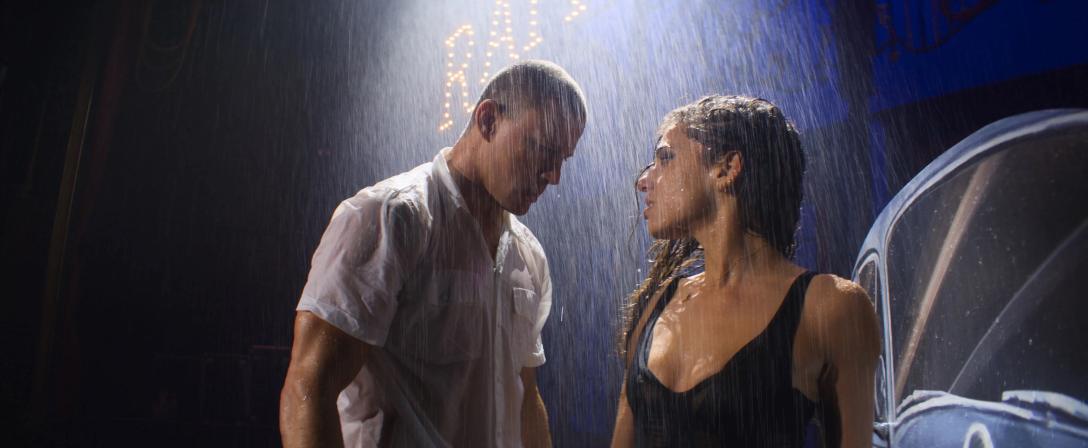
Directed by Steven Soderbergh. Written by Reid Carolin
In Magic Mike’s Last Dance, the conclusion to the unlikely trilogy about Mike Lane and his clothes-shedding ways of stripperhood, director Steven Soderbergh wants to do right by his main man.
Mike and his co-stars started out as stigmatized practitioners of the dark arts of pantywetting as strippers from Tampa, trying to forge ahead through economic insecurities. It was not glamorous work, and it was actually quite thankless, even if it allowed some professional satisfaction. Mike and his world was always a little hidden away, and its seedy corners was part of the charm. Now, the third installment takes it out of its native Florida, out of two-bit clubs, out of the hands of grabby middle-aged women, and sails it across the Atlantic Ocean, to England, to high society.
With the new paygrade comes a need for intellectualizing the carnal, too, and Mike’s meaty medium has its anthropological origins discussed, its societal function mapped, and societal import weighed. Put that sweaty thong away and try this elbow-patched tweed jacket on for size.
It’s far less sticky, it’s far less grimy. A fantasy victory lap in broad daylight for creatures of the night, and while Last Dance has some of the steamiest dance routines put on film, some of that subversive edge has been lost. It’s still a wild romp, thrilling and goofy, but the dance takes place in the ballroom you were never that interested to see, not the backroom you were always curious about.
To start, however, economic insecurities are back. We catch up with Mike (Channing Tatum) penniless once more after the pandemic wiped out his fledgling furniture business. He’s tending bar at some fundraiser, and the host, Maxandra (Salma Hayek) is tipped off to his former occupation. She’s going through a messy divorce and wants to take her mind off things, so she makes a proposal: $6,000 for Magic Mike’s last dance. Mike does indeed deliver on the magic, and suddenly, he’s got an even more involved job offer: come to England for a month and direct a stripper-focused revival of a dusty mainstay at one of London’s famous theaters.
Yes, a little hard to believe, but once you’ve seen said $6,000 dance, you’ll think Mike underpaid. To discuss it in detail would be like trying to describe the Grand Canyon. Some things you just got to see for yourself, and part of me wishes Magic Mike’s Last Dance was a short film that culminated, or climaxed, right here, so I could call it a terrific summation of the movies’ ethos and celebrate it forever.
But it doesn’t of course, and thankfully there’s another stunner at the end, making for two high points between which Soderbergh can string a series of lesser dance acts like pearls on a string. These moments are still what’s unique to Magic Mike and its strength.
Hayek and Tatum have chemistry, and if they sold me lust rather than love, I’d buy it, but Last Dance’s romance du jour ain’t it, and that has been the case for the series as a whole, where Magic Mike’s offering of the fantasy is waylaid by a heteronormative insistence on Mike Lane giving and receiving emotional satisfaction from one “special lady”. The series’ failing in this regard is at least true to the central exchange of Mike’s profession where he performs the role of a lover only for the length of a song, and only that. The spell’s broken once it fades. In short: Mike sells it on stage. Magic Mike does not.
The central coupling also means Last Dance is also more of a two-person choreography than the group performance that brought a lot of joy to predecessor XXL. Gone are Dallas, Big Dick Richie and Tarzan, and in their stead Mike hires a troupe of elite dancers who’ve never had to perform with their bodies in that particular way. They’re not more interesting than their dance moves. The talent isn’t as charismatic when you recruit from TikTok instead of the trenches.
Playing Mike still seems as natural as walking for Channing Tatum, who delivers on stage and in his lines, delivery, and comedic timing, and you sense everyone involved wants to give Mike a proper sendoff as a decade-defining representation of sexualized masculinity. The need to clean him up and make high-brow something concerned with what happens below the waist ultimately lessens him. If Last Dance lives up to its name, it will at least be an accurate summation of the trilogy as a whole, offering both the heady bump and the repressed grind.
 Mikkel Frederiksen