Directed by Sam Raimi. Written by Simon Moore
The mind has no time to be bored watching The Quick And The Dead, Sam Raimi’s shoot-em-up western and movie-fied comic book. Its frantic editing, crash zooms, scissor-finger cuts and never-say-die action sequences won’t allow it.
The bullets never stop flying, the fisticuffs won’t cease, and the cartoonish characters it features only rest their lips when scowling before a duel, throwing back booze or spitting out blood. It’s a filmmaking concoction of Pop Rocks and Adderall.
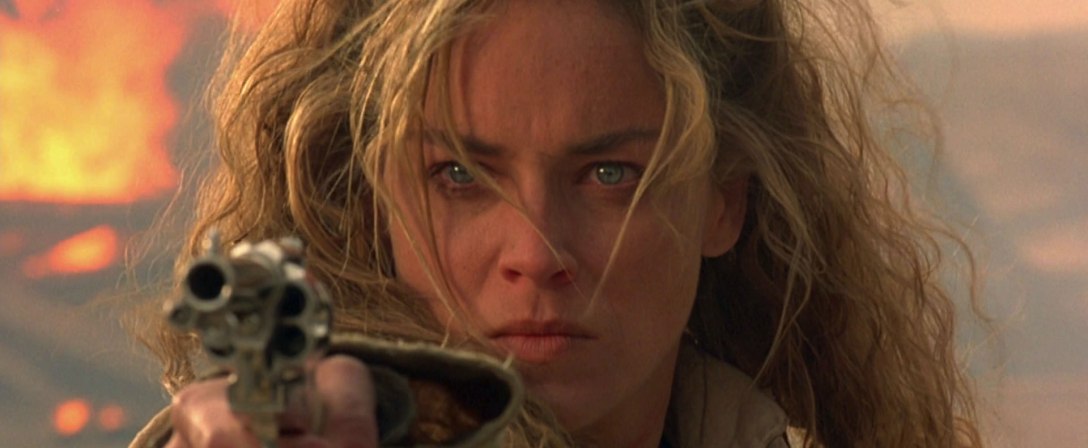
Sharon Stone stars as Ellen, a lonely rider who enters a dusty town under the yoke of a brutal gunman who by the terror of his quickdraw has everyone pitching him 50 cents of every dollar they make. Once a year he arranges a shootout tournament in order to weed out opponents, and he’s been very successful so far. Ellen doesn’t cut an assassin’s figure, so what’s her play?
Gene Hackman stars as Herod, said gunman. Three years prior, Hackman played a similar tyrannical strongman in Clint Eastwood’s Unforgiven, and the two performances play together like alto and tenor saxophones, only here it’s the villainy that remains. Hackman’s got talent leaking out every pore, and lends gravity to a character that could easily topple over in a tumbleweed-rolling breeze. In a silly movie, he’s a believable evil.
Alongside him, Russell Crowe plays a former gunfighter trying to atone in the eyes of the lord, renouncing violence but finding it hard to do so in a world wrapped up in it. He does something interesting with the material, playing it straight and matching the wackiness with equal sanctified suffering. It’s like someone auditioning for clown college with a Shakespeare soliloquy.
The differing but equally respectable performances from Crowe and Hackman are joined by Sharon Stone’s, which can best be described as… uneven. She does some things well, staring down fools with a look that’ll wither a rattlesnake down to a twisting leaf, but Raimi requires her to be afraid and vulnerable too, and returns are diminishing. Back and forth Stone goes between scenes, leaving you to wonder who’s showing up with every cut.
Stone’s emblematic of The Quick and The Dead in how the fun parts work well, and those that require pathos do not. When anything worthwhile has to be conveyed, Raimi’s movie struggles to get its shots off, and there certainly aren’t many bullseyes when characters talk of their trauma, want for approval, struggle to go straight, and fight to do what they know they must, but don’t know how. Thankfully, there aren’t a lot of these moments, but they do stand out a lot more for that same reason, offering insight and nuance that only teenage boys will be impressed by.
Still, there’s a lot to be said for the entertainment value of Raimi’s visual style, which leaps headlong into the genre’s trappings and injects illegal stimulants. The amount of style points break the scale, and its supercharged transformation of its tropes is a marked modernization of an old genre. While it also makes it feel dated today, that’s only a good thing when its style is this thorough. An homage almost straining to hold all the elements it wants to include, but it arrives on the back of its enthusiasm to provide a thrill ride that’s all gas, no brakes.
 Mikkel Frederiksen