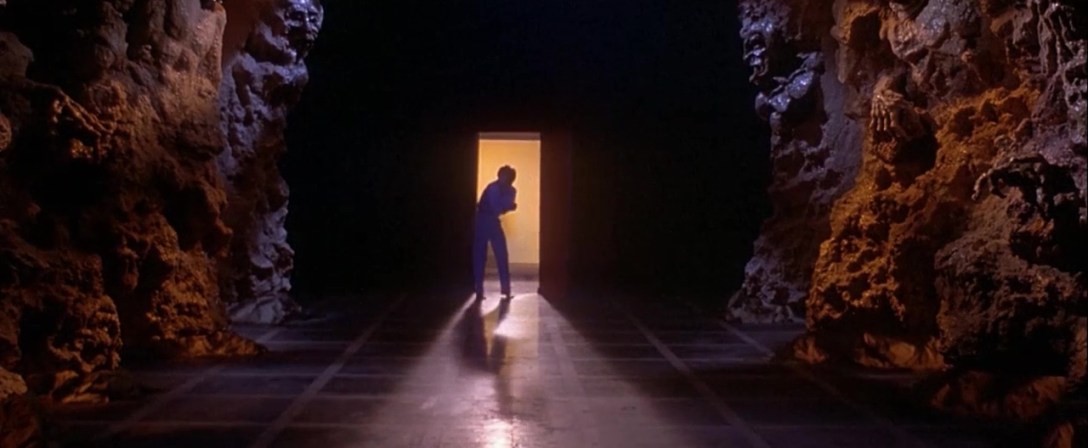
Written and directed by Dario Argento
Dario Argento is a master at what he does, and Inferno shows flashes of that mastery. It’s also a boring affair that brings out the worst in him.
The good: his unmistakable sense of style, brilliant use of lighting, and fondness for frenzied suspense. It’s all here. Feast your eyes even as some of the cursed violence makes you wince.
The bad: A forgettable cast of characters wherein there’s not one you’d like to know a little better. Not that you even get a chance to, as the narrative of Inferno is simply a conveyor belt for people to ride on as they make their way towards the inescapable butcher’s knife. A story that’s likewise wafer-thin, asking you to stick around for the bloodletting and nothing else. A house made of straw.
Inferno is about houses, and Argento gets underway with his usual economy, immediately outlining the entire plot. A woman reads a dusty book that speaks of three mythological sisters that live in three buildings: in Freiburg, in Rome, and in New York.
It also tells of how dangerous they are, and not to be messed with, but she’s a curious sort, so she pokes around the very building she lives in, believing it to be one of the mentioned dwellings. She soon disappears, but not before sending a letter to her brother who studies music in Rome. He gets in on the mystery too, and drags along a cast of unfortunate friends new and old, as he tries to figure out what’s going on and what happened to his sister.
It’s a frighteningly dull story, and it’s almost frustrating, because when Argento wants, he can dial it up and deliver. There’s some scary stuff in Inferno and there are plenty of great standalone scenes that show Argento’s fundamentals are intact, and he just chooses not to apply them at times.
Consistently great is the entire production design, and in particular the lighting. In what is almost Argento 101, it’s constantly flooded with some stark shade of color, and in Inferno, it’s either blue or red. The same way masters of black-and-white used lighting for striking storytelling, so does Argento, only he has the entire palette to work with. It simply pops. Modern movies don’t try to emulate Argento’s style and vivid color schemes, which is fair, but I can’t help but think of how most things nowadays would look like gruel held up against a movie like Inferno.
Blogs like moviebarcode do a good job of distilling a movie’s visual expression, and comparing past decades to movies released post-Y2K is a good way to discern this flattening of our use of color. Screens long for a return…
One should ask more of Inferno than just some gorgeous cinematography, however, and beyond the creative artistry behind the camera, it offers little. Inferno is a loose sequel to Suspiria (1977) and while that movie shares the virtues of Inferno, it has none of its shortcomings. Inferno manages no world-building when it already had half its work done for it, the central pursuit never amounts to more than happenstance, and there’s no character worth consideration, let alone investment. In comparison, Inferno becomes a glaring lesser-than.
 Mikkel Frederiksen