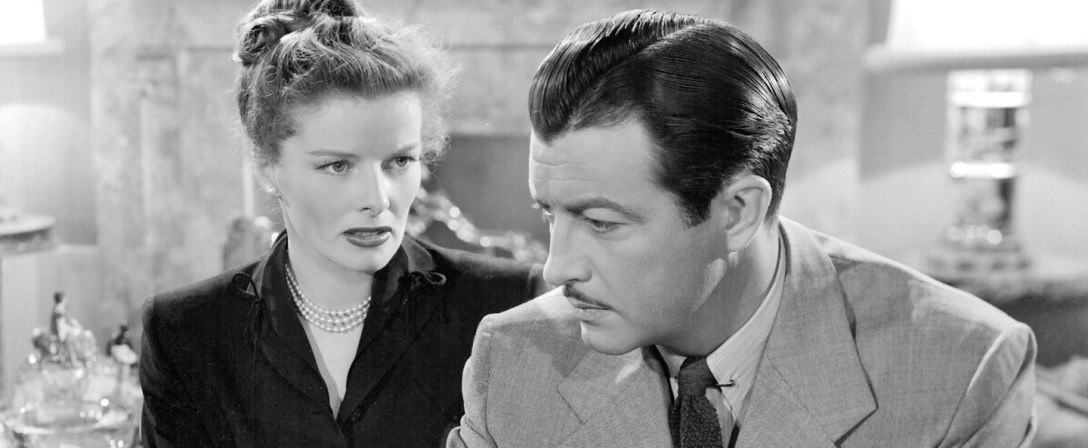
Directed by Vincente Minnelli. Written by Edward Chodorov
Insecurity is a gateway drug that can lead to worse emotions, but in Vincente Minnelli’s Undercurrent, the story of a middle-aged woman’s meteoric marriage to a man who proves mad, it’s the key to the gates of hell.
She’s not impervious to it. As Ann, a woman advanced in years (by the standards of the time, mind you, being unwed at her age basically makes her a millennial), she’s all but resigned to living out her life working alongside her father, a brilliant scientist. One day Alan Garroway, an industry titan, alights on their doorstep, and the time from first sight to marriage is basically a crossfade between scenes.
High society is a brave new world for Ann, trading beakers and bunsen burners for cufflinks and ball gowns, and she’s running low on oxygen in the rarefied air. She clutches at her hubby for assurance, and he loves it. “You belong to me,” he says in a hushed voice. A little ominous.
It soon becomes very ominous as Ann catches inconsistencies in Alan’s stories about his past, and any mention of a missing brother sends him immediately into the red. Ann loves her man, but she still can’t help but dig a little deeper.
Edward Chodorov’s script was based on a short story published in a magazine and it shows. Much of what we consider world building is glanced over in order to get to the more dramatic bits, and the movie hinges on Ann’s deep love for her husband, but what that love is based on is anyone’s guess. An early scene sees Ann’s father explain the act of falling in love as simple chemistry, where the addition of one element to another causes an instant reaction that solidifies into natural law. A tidy analogy, but I’m a see-it-to-believe-it kind of guy.
With so little time spent in building up the central relationship, it’s therefore surprising Undercurrent takes so long to tell its story, but it’s because it retraces its steps to make the same points about Ann’s insecurity and Alan’s jealousy, but never bothering with proving to us why they bother to feel that way. In simple terms: there’s a hefty rind of fat on this steak.
As Ann, Katherine Hepburn plays against character, but she is, it’s almost redundant to say, excellent. As unusual it is to see Hepburn reduced to a nervous flower, it’s also enthralling to see her do it so well. In her father’s home, Ann’s in her element, and so Hepburn seems as well. When Ann’s then on enemy turf and a shadow of herself, you get to experience Hepburn shed every idea of what kind of performance she’s capable of.
Minnelli’s famous for his musicals, and the standout elements of Undercurrent are the ones where the drama turned up for spectacle, be they Alan’s fits of angry paranoia, or a thrilling finale, but the hits are few and far in between. At least Undercurrent, with its exploration of ruinous jealousy and madness, is novel in its subject matter, merging melodrama with thriller.
Robert Mitchum shows up in what’s little more than a cameo, making Undercurrent more of an unassuming footnote in the careers of all-time greats whose defining works lie elsewhere. Mitchum’s underutilization is symptomatic as a whole of this movie where there’s plenty of great raw material to work with, but a misplaced emphasis on cheap, simplified emotion drags the entire affair out to sea.
 Mikkel Frederiksen