Written and directed by Jeff Nichols
Jeff Nichols’ The Bikeriders is a bit of biker worship. It has the smell of gasoline and sweat, the feel of sticky beer spills and oil-stained hands, the sounds of engines roaring and leather jackets crinkling. It has the spectacle of life’s rough edges, from hard stares to fistfights, and its tension lies in the outsider lifestyle butting up against the guard rails of middle-class existence.
It tells the story of the rise and fall of a biker club started because the founder saw Marlon Brando in The Wild One and latched onto his rebellious nature and the paraphernalia that comes with it. With The Bikeriders based on a book of photographs by Danny Lyon, you sense Jeff Nichols’ inspiration comes from the same place.
It’s about the feeling of freedom, carving out a place for oneself in the negative spaces of society and making it yours. It’s also about the impossibility of truly living that way, as its main characters are either middle-class folks with day jobs, mortgages, and school-aged children, or ultimately headed there.
So, for the most part, it’s the coming-of-age story for a way of life. Of bikers, before they came synonymous with a grizzled, leather-wearing version of organized crime. The innocent weekend warrior hobby that resonated with adrift men and provided brotherhood for a moment before life’s real outcasts infiltrated it.
Nichols’ world-building is the real deal. The Bikeriders offers immersion in a subculture with perfect evocation of a time and place. The work, above and below the line, is stellar. Nichols’ fascination with Lyon’s portraits of these men and women is paid fitting tribute to, and he’s also a good enough writer to put a tight story together that provides enough of a skeleton to build the fantasy around.
That same story holds no surprises, though, offering a classic tale of a phenomenon that started with the right intentions, but grew too big to feasibly stay connected to that initial spirit. History’s littered with political movements, subcultures, and fandoms that experienced the same fate.
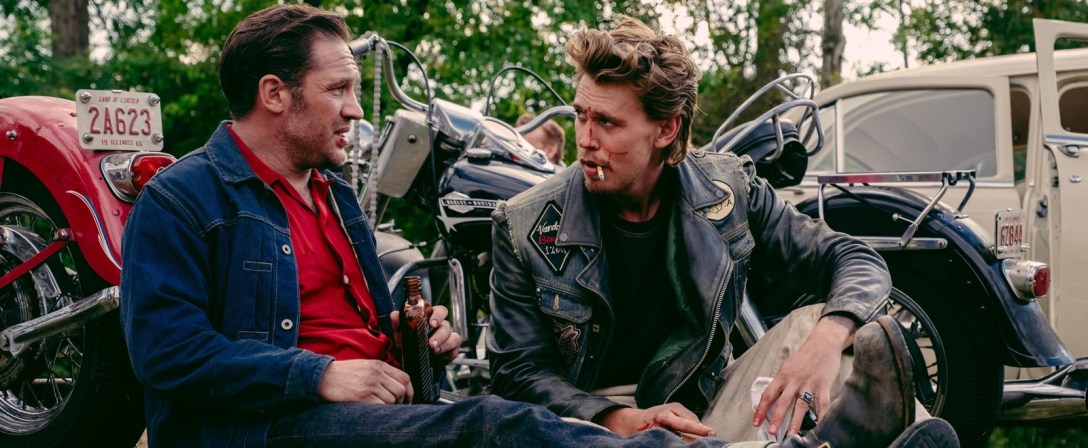
Tom Hardy plays biker club president Johnny, a tough-as-they-come wolverine of a man who’s still a decent person underneath it all. Jodie Comer’s underutilized as Kathy, seeing as she’s more of a narrator than the intrinsic part of the plot the story suggests she is. Her accent work putting on a Chicago accent is admirable, but it’s also conspicuous when no one else on the cast bothers with one.
Comer’s fate as exposition provider is unfortunate, because she’s central to the story as one half of the central relationship, and she’s essentially sidelined in favor of the man in the middle: Austin Butler’s Benny. He’s a rebel archetype who doesn’t ask anything of anyone, and gives nothing in return. All he wants is the freedom his ride provides him. What’s to become of a man like this? The fate of this genuine outsider is the central question of The Bikeriders.
Like Comer’s accent, Butler’s performance is conspicuous for the wrong reasons. It’s a James Dean impression, right down to the smoldering pout. If there’s a place where The Bikeriders seem more concerned with evoking the imagined vibes of a given time and place than giving us something to engage with, it’s here, as Butler’s performance seems more geared towards being freeze-framed, made into a poster, and hung on walls to inspire superficial daydreams. Butler’s homage forgets Dean did actually emote too, and Butler doesn’t go digging with Benny, the character through which we’re meant to explore the outsider’s psyche.
The Bikeriders does get under the skin of some of its characters. Michael Shannon, a stalwart on Nichols’ call sheet, plays Zipco, an aging biker (he’s got the hearing loss to show for it) whose resentment of institutions is slowly revealed to be the scorned frustration of someone left outside of those same institutions. He does more with three scenes than Butler does with the rest.
As the credits begin to roll, photos taken from Danny Lyon’s book accompany the names. As you watch the pictures fade in and out, you’re struck by how Nichols has managed to turn these pictures into almost identical shots, and it becomes clear how they struck Nichols and inspired a desire to tell a story centered around these marginal existences and those who loved them.
Watching The Bikeriders, it’s also easy to understand Nichols’ ability as a filmmaker, as he evokes the culture contained within these images with a seeming effortlessness. He ripped those images straight off the book they were printed in.
There’s a feeling, however, that Nichols looks at those portrayed with a fan’s reverence. A reverence that strips its subjects of the humanity that would have made them real, and it unfortunately keeps The Bikeriders from truly turning into the oil-, blood-, and sweat-stained drama about outcasts and iconoclasts it could have been.
 Mikkel Frederiksen
[…] We only see his lower half at first, and it’s enough. His black denim-clad legs stretched out on his single bed, blaring music to drown out the complaints of his mother. He’s in repose, inhaling cigarettes and snuffing them out in a filling ashtray. He is delinquent youth personified, a small vertical scar accentuating his right cheek when he finally sits up for us to look at all of him. A leather jacket completes the rebellious look, putting him alongside James Dean and Marlon Brando in The Wild One as beautiful roughriders, the type of outsider icon Austin Butler would pay homage to in The Outsiders. […]
LikeLike