Written and directed by Robert Greene
It’s a disgusting fact that mile-long traffic queues on highways are sometimes not caused by an accident up ahead, but by an accident in the opposing lane. Traffic grinds to a halt because people slow down to gawk at the gore.
Kate Plays Christine, Robert Greene’s documentary about an actress’ work to play the part of a news anchor who killed herself on air in 1974, is a commentary on this phenomenon, a pointed finger at our morbid fascination with violence and bloody misery. The finger also points at the media, who slops sensationalized bloodshed into our troughs for us to gorge on; the finger joins its brothers to extend a hand for all of us to think about our feelings towards suicide.
These considerations aren’t at the forefront, however. They play at the circumference, introduced by the people Kate comes into contact with: journalists, gun store clerks, actors, psychiatrists. They play second, third, and fourth fiddle to the increasing distress of Kate trying to get into the troubled headspace of a real person of whom little footage remains.
Greene is fascinated with the liminal space dramatized fact occupies in documentary filmmaking, from reenacting the forced deportation of striking workers with their living descendants in Bisbee ‘17 to getting in with a crowd of semi-pro wrestlers in Fake It So Real.
It reaches a fine point in Kate Plays Christine as Kate Lyn Sheil plays a version of herself as an actress trying to get under the skin of this new role. We know it’s not authentic, because she tells us so, expressing a little uncertainty about externalizing a lot of her creative process that would usually happen in privacy and silence. Faking it to make it real.
It made for a powerful watch in Bisbee ‘17 because the obvious artifice made history real for the living descendants who still lived divided in their opinion of who was in the wrong during a labor dispute dating back 100 years. Bisbee ‘17 was Greene’s next film after Kate Plays Christine, and he’s still ironing out the kinks here.
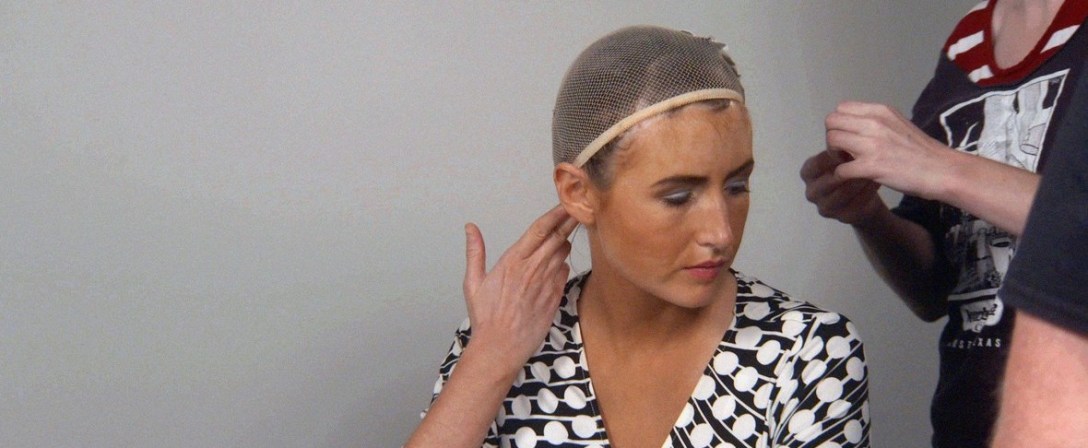
It’s initially a fairly straightforward inside look at the actor’s craft. The mundane handiwork of researching historical facts, clothing, and hair. The deeper prodding and psychological immersion into the mind of a depressed person. Then, reality begins to blur for Kate as she retraces Christine’s steps as the character heading towards an awful end.
The fluid dynamics of character work is fascinating. An actor delving into their own memories to fuel their empathy and understanding of a character. The struggle to reconcile with what lies outside of their comprehension. The deteriorating headspace the pressure can produce. Greene overdirects, however, and Kate’s journey becomes overly dramatic, with Greene’s decision-making too forceful and manipulative. For a movie that wants to portray a slow breakdown, Greene sure loves to prod you in the back to speed things along.
The compelling elements of Kate Plays Christine, namely its exploration of media accountability and our understanding of mental health issues, are relegated to the sidelines in favor of this central artistic pursuit. The documentary that Greene sets out to make is swallowed by a work of fiction about Sheil’s dark journey into Christine. That movie is a melodramatic one.
Greene remains a distinctive filmmaker who’s not afraid to show his hand and use artifice to get at a deeper, emotional truth of a matter. He shares this inclination with the likes of Joshua Oppenheimer, who’s thanked in the credits, and Werner Herzog, who often speaks of the value of “ecstatic truth” as something “truer” than the simple facts of the matter.
It’s easy to see how the story of Christine Chubbuck, with its shocking conclusion and factual dearth, would make a fascinating subject for Greene, but in his overbearing execution of the dramatic elements he fails to reach the heights of his peers with Kate Plays Christine.
 Mikkel Frederiksen