Directed by Andrei Tarkovsky. Written by Tonino Guerra and Andrei Tarkovsky
Memory lane becomes an unbeaten path in Andrei Tarkovsky’s Nostalghia, a confounding story of a writer’s trip to Italy and the feelings it inspires. While its impenetrable story keeps you at arm’s length, it’s only so you may better gaze upon the artistry, as Tarkovsky’s poetic sensibility is on full display, as well as his considerable filmmaking skill. Those that like to “solve” the movies they watch will squirm at the feet of Nostalghia, but those who partake in the pleasures of the eye will look up in wonder.
A Russian author (Oleg Yankovsky) is traveling around Italy with an interpreter (Domiziana Giordano) while doing research for a book he’s writing on the life and times of an 18th century Russian composer, but the work trip dissolves into a reminiscence on the author’s childhood, with him falling in and out of his past at a pace beyond his control, memories washing over the tangible present like tidal waves.
Our protagonist is a man with his head in a few places: his recollections, an ongoing conversation with a local man about what’s to become of the world, his work, and the present, where a tense relationship with his translator poses its own questions. Second in line are the ghosts that inform some of the present, his unseen but mentioned wife and child back in Soviet Russia.
His headspace is a porous thing and we flit in and out. The search for meaning is an arduous journey in Tarkovsky’s film, and to stay engaged is no mean feat. I wouldn’t tsk-tsk someone who falls by the wayside as they move through Nostalghia.
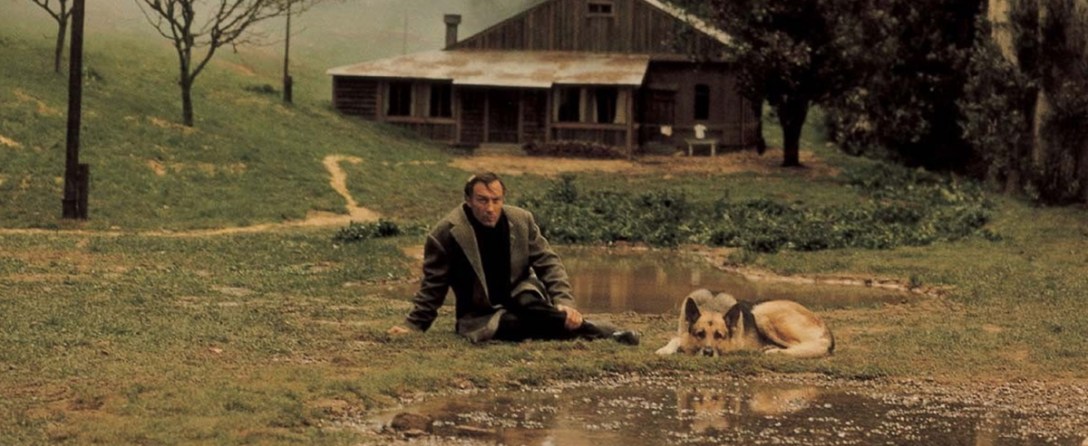
The red line that runs through the movie is a self-determined wisp of smoke whose movements we’re left to interpret, making concrete observations exceedingly difficult, in particular any that feel intellectually satisfying. Visual satisfaction, however, is immediate and powerful. Tarkovsky proves himself every bit the master at constructing images and reaching deep down within you to leave you astir.
He offers the timeless mystery of fog rolling off the hills, the spiritual intensity of a small chamber intricate with pillars and arched ceilings wherein hundreds of lit candles make everything come alive, and it’s not just what’s in front of the lens that inspires. It’s also how Tarkovsky moves his lens, with small shifts forming a cinematic language rooted in subtle presentation of the aforementioned splendor.
The impression Nostalghia leaves you with is that you’ve just watched a piece of art moving at 24 frames a second, with every image dense with meaning and bereft of context to guide your understanding. An act of crowd service might have been for Tarkovsky to insert small pauses for his audience to consider what they just saw, but not even that might be enough. Some things you must simply absorb and let your mind tinker with in the days, weeks, months, and years to follow.
Nostalghia is a wild horse running along the horizon making use of the open space. Dedicated scholarship can shrink that open space, I’m sure, and offer something resembling accurate interpretation, but there’s already an obvious visceral pleasure to be found here, full of craftsmanship and a poet’s kaleidoscope sensibility where meaning and pleasure swivels on the smallest of details.
 Mikkel Frederiksen