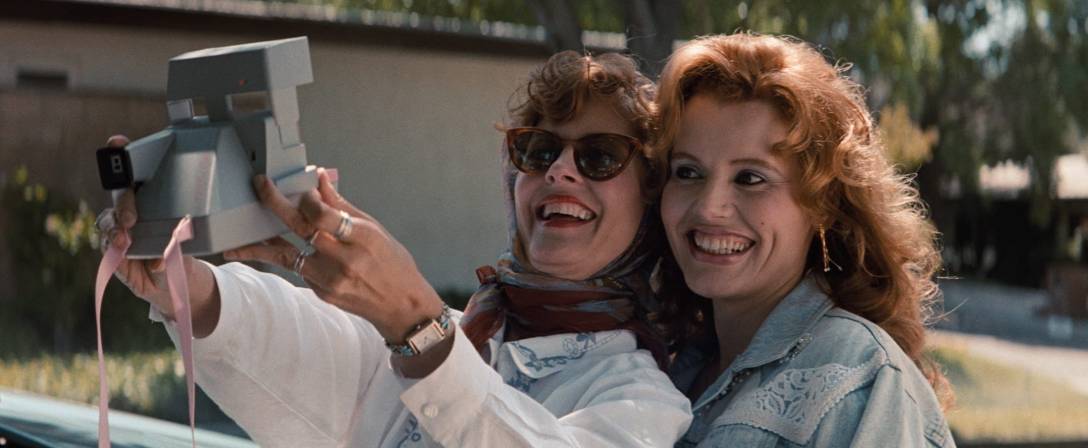
Directed by Ridley Scott. Written by Callie Khouri
A neo-western road trip movie about two women’s liberation from the ties that bind them, Thelma & Louise ticks off some unlikely boxes. It has the elating release moments of self-discovery can produce, real punch, the wistful twinge a thwarted dream can elicit, and the unbound fun of a joyride. Thirty-three years old. Hasn’t aged a day.
We join Thelma (Geena Davis) and Louise (Susan Sarandon) on that joyride, but first, Thelma needs coaxing out of her kitchen where her dismissive windbag of a husband keeps her confined in domesticity. Louise, calling from her busy waitress job that requires her to wear a ridiculous uniform in service of some customer service fantasy, is trying to convince Thelma to pluck up the courage to tell her hubby she’s going on a girl’s trip for a couple of days. They both need to get out of town to let off some steam. They need it bad.
Thelma ends up avoiding the confrontation and just heading out, leaving a note and Friday’s dinner in the microwave, and this small act of defiance turns into a parking lot shooting and a (wo)manhunt that’ll see the two friends cross state borders in a mint green Ford Thunderbird and cross into parts of themselves they never thought possible.
Thelma & Louise is about outlaws, if bucking against the patriarchy and its sexist, sleazebag, patronizing ways was a crime. It derides piggish men, figuratively punching them in the face repeatedly, living out a revenge fantasy on every unwanted catcall, approach, or touch. More than that, offers an endlessly cool vision of women living for themselves, as themselves, whatever that looks like. It’s heady viewing.
It understands like few other films the transformative and liberating power of the open road and the grand landscape beyond it. As Thelma and Louise tear across America, Scott’s film can’t help but look to the heavens, letting the sky above dominate much of the frame, and cast many longing looks at the vistas stretching out behind this go-for-broke Thunderbird carrying the two wanted women along. The vast open spaces and their promise of escape electrify.
A good bit of it is shot on dusty roads snaking through Monument Valley, sight of every iconic western you can think of, and Hans Zimmer’s score overlays a twangy guitar reverbing into eternity, completing an audiovisual bit of mythmaking. Scott uses the iconography of the frontier to tell this story of liberation, leaning on its American syntax, but also recasting it in service of this feminist struggle.
Sarandon and Davis don cowboy boots, jeans, torn denim shirts, and look iconic doing so. Sarandon’s got a steel spine playing Louise, the headstrong, slightly wearier of life, older sister to Davis’ Thelma, a sheltered housewife, and to see them both grow over the course of Scott’s movie is satisfying beyond measure. The two deliver a pitch-perfect duet as friends and all that entails. The roles and power dynamics, the ride-or-die support and exasperated sighs a friendship can elicit, often within the same conversation. They’re far from perfect, as individuals and together, but they’re not letting go.
Thelma & Louise is a character-driven masterpiece, a lifted middle-finger to the many awful men forcing themselves on society, a love letter to the American Southwest, and a searing story of self-discovery. Legendary for a reason.
 Mikkel Frederiksen