Written and directed by Olivier Assayas
There’s a lot of life in art and a lot of said art in Clouds of Sils Maria, Olivier Assayas’ metatextual treatise on the gap between performance and real life, as the writer-director casts Juliette Binoche as an actress much like herself who’s made to confront time’s passing when she’s cast in a different role in the play that made her famous.
Juliette Binoche plays Maria Enders, a legend of the screen with a long career behind her. Famous, respected, but now in middle-age, which for actresses can feel like one foot in the grave. It comes with the stereotypical frustrations, because the roles she is offered aren’t necessarily how she sees herself and all around her are signs that her heyday is over. Cliché emotional squibbles abound, including vanity and insecurity feeding off each other.
She’s not quite the cautionary tale of Norma Desmond in Sunset Boulevard, but you don’t need to be a Hollywood insider for Maria to seem familiar. At her flank is Kristen Stewart as her assistant/creative sparring partner Valentine, who has a phone glued to one hand and Maria’s mood cupped in the other. She’s a subordinate, best friend, and therapist all in one.
Their relationship will be explored, tugged at, and strained, as Maria’s been offered a part in the play that put her on the map 20 years ago, only the part is the role of an older woman tragically in love with the character she played as an up-and-comer. Easy to see why the director would find that compelling for his production, very easy to see why Maria’s not that keen on the suggestion. She accepts, however, so it’s time for some introspective roleplaying.
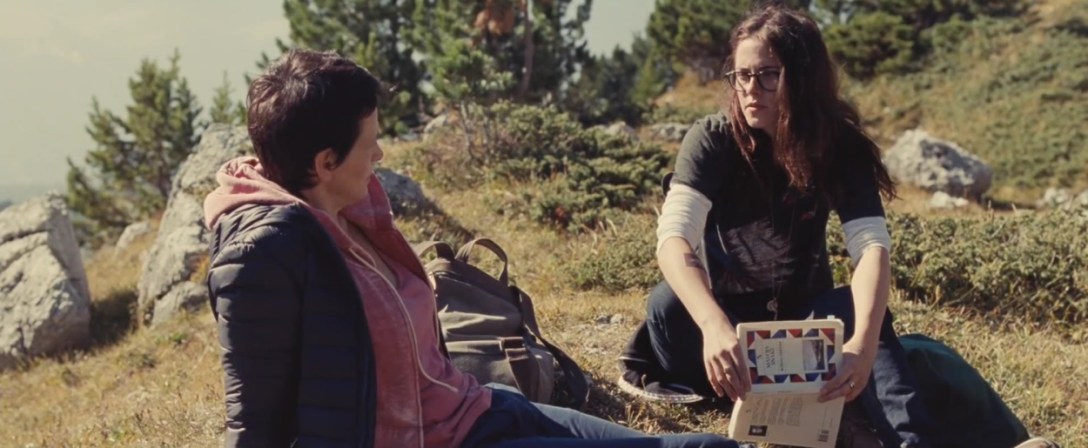
The kernel of Assayas’ movie is in the liminal space between reality and art for Maria and whether she can come to terms with her career. She and Valentine sequester themselves at a cottage in the Alps to work on the part, and it’s not just any cottage: it’s the home of the recently deceased director who gave Maria her breakthrough role. Ghosts aplenty and a house-sized memento mori for Maria to ponder.
The metatextual is familiar turf for Assayas, whose 1996 film Irma Vep saw Maggie Cheung play herself in a movie about the production of the very same movie. The snake almost ate itself back then, but the daring, idiosyncratic foray into the dysfunction of moviemaking was an intense ride aboard a runaway train.
Not so here, 18 years down the line for Assayas. Sils Maria takes a languid approach, full of rehearsal scenes where Maria and Valentine act, comment, and discuss characters on the surface but are talking about themselves. You’d think the walls would shrink as frustrations mount, but a lot of it remains unsaid in Assayas’ hands, making Sils Maria an icy affair where silences and looks speak the loudest.
Yorick Le Saux’s cinematography is pallid to compliment the subdued narrative and it makes Sils Maria a rather lethargic fish, flopping around here and there so the light catches in its scales, but only for moments. It never quite pulls you in. Most of Sils Maria gets shown up by the Alps, magnificent and dramatic as they provide the backdrop for Maria and Valentina’s hikes. You know you’re not attention-grabbing when people look past you to gaze at the backdrop.
The mountains have an equal in Binoche, however, as she delivers the cerebral and emotionally intelligent take Assayas’ wants to give about dramatic performance and how life can inform art. Binoche is a coquettish girl, bitter crone, and everything in between as Maria, making her own point about how manufactured perception can flatten a person in the public eye. Binoche makes Maria real, recognizable, surprising, human, warm to the touch at times and exasperating at other times.
Even if Clouds of Sils Maria is ultimately an unaffecting metatextual actor’s workshop, it remains a testament to Bincohe’s greatness how she takes what are only embers and makes a fire out of it.
 Mikkel Frederiksen