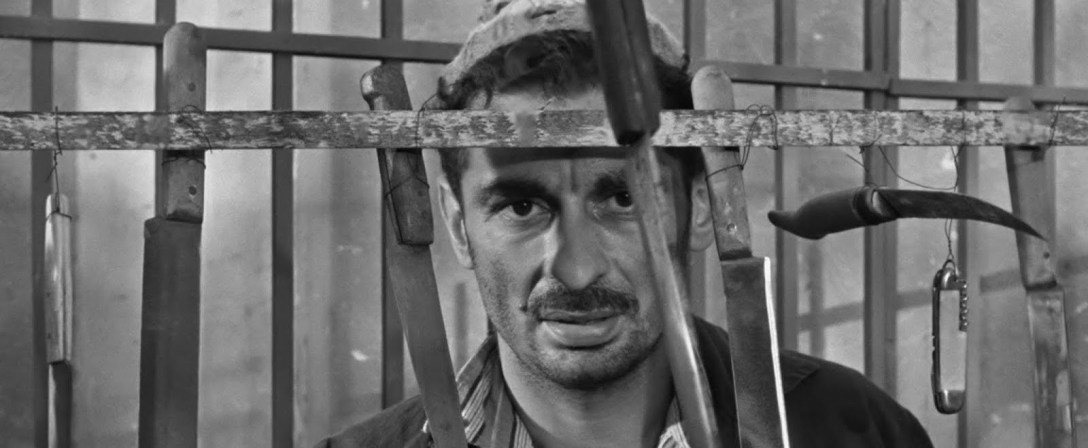
Directed by Youssef Chahine. Written by Abdel Hai Adib
The central train station of Cairo is a bustling place where trains arrive and leave every minute, this hub just another node in a world that spins faster than ever, connected and full of opportunity. The ecosystem of the station, counting porters, newspapermen, women selling soft drinks, and all their overbearing bosses, is gridlocked, however.
The laborers toil away making scratch, and tensions are mounting. Abu Siri (Farid Shawqi) with his imposing physique and fixed brow, threatens to organize a union for anyone who’ll join, and he’s planning on wedding Hanuma (Hind Rustum), Cairo station’s siren hawking cold Pepsis and Cokes, driving men mad with lust and frustration.
Frustrated by this lust, perhaps more than anyone, is Qinawi, a man limping around the station selling the newspapers under his arm. He’s got more than a sweet eye for Hanuma, as she’s the closest thing to the bombshell pinup models he likes to cut out of magazines and plaster to the walls of his little shack, a shrine to haram fantasies.
Not a fantasy, but a frightening reality: If you buy one of the newspapers Qinawi carries around, its headline will tell you of a mad killer stalking Cairo’s streets, cutting up women. Temperatures are climbing, in the air and on the ground.
Cairo Station’s a great deal, offering 120 minutes worth of movie in just 75. In those 75 minutes, you’ll get labor strife, a knife-wielding killer, psychosexual obsession, and in less stressful fare, young lovers circling each other while an older pair laboriously works to save for their wedding.
Chahine’s movie straddles that line between hard realities and sordid thrill, making labor politics and blue collar unrest the backdrop for a pulpy plot of crazed madmen and grizzly stabbings. It’s also a flash portrait of a society caught in the schism brought on by modernity, as it shows the changing social structures in the wake of the rise of organized labor, and insinuates a nefarious influence of Western sexiness. The future’s a wild bronco that’ll do its best to buck you off.
Cairo Station is easy to get on and stay engaged with, though. Partly because of Chahine’s brisk pace, which gives you little time to think twice, but also because energy pores out of every shot, whether it’s heated argument, dramatic and comedic, or an extended musical act that’s as much a spectacle as it is a way of moving the plot forward. It’s a raucous energy, feeding off the masses that occupy most shots of Cairo Station.
This energy sees Cairo Station through a fairly barebones and slapped together story that does not resolve all that neatly as it favors its pulp fiction over its socio-economic foundation, but it’s fun while it lasts, and it offers that heady exploratory joy of experiencing a different cinematic language coming from a time and place unfamiliar if you’re like me and new to Chahine’s work.
 Mikkel Frederiksen