Directed by Henri Verneuil. Written by Michel Audiard and Albert Simonin
Some movies are best remembered in still images. Detached from the rest of the movie, what you see is what you get: a striking composition, a gorgeous costume, an exquisite bit of framing. This particularly appeals in the case of movie stars, who tend to look every bit the part. You press play, however, and the spell is broken. They now have to move, say things, take action, and all movement carries the risk of being unflattering.
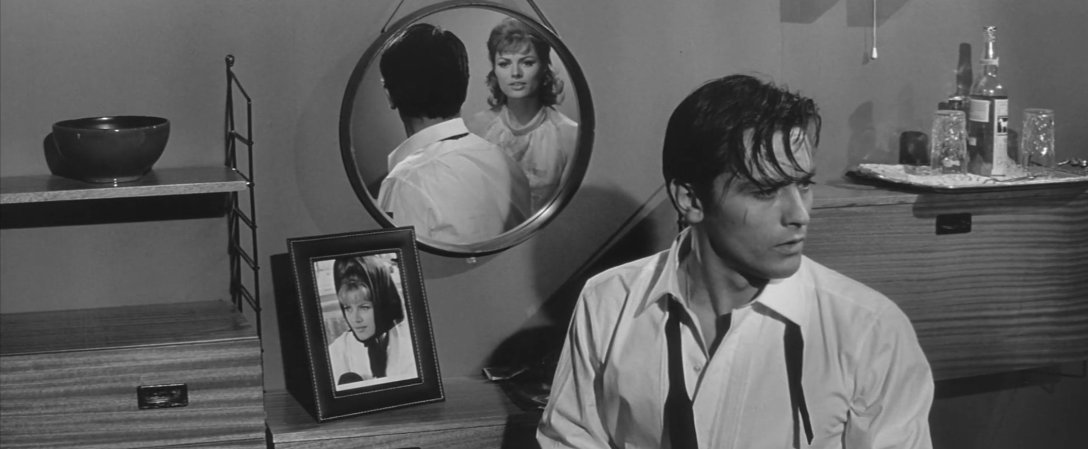
Any Number Can Win, Henri Verneuil’s otherwise middling heist movie, is best when it stands still and looks at Alain Delon. As Francis, an up-and-coming, rough-around-the-edges thief, there’s not a frame Delon doesn’t burn right through, doesn’t demand your attention in, doesn’t transcend.
We only see his lower half at first, and it’s enough. His black denim-clad legs stretched out on his single bed, blaring music to drown out the complaints of his mother. He’s in repose, inhaling cigarettes and snuffing them out in a filling ashtray. He is delinquent youth personified, a small vertical scar accentuating his right cheek when he finally sits up for us to look at all of him. A leather jacket completes the rebellious look, putting him alongside James Dean and Marlon Brando in The Wild One as beautiful roughriders, the type of outsider icon Austin Butler would pay homage to in The Outsiders.
As Francis meets Charles, an aging con man who’s recently out of jail and looking for a partner to take down one last big score, Delon morphs into the ice-cold elegance we know him best as. Posing as an old money playboy so he can gain access to a casino’s bank vault, he wears tuxedos like they’re tracksuits, the garments falling with effortless grace, perfectly into place however he composes himself.
Delon’s star power shines over Any Number Can Win, and opposite Delon, French cinema icon Jean Gabin stars as Charles, the old guard trying to go into the sunset on his own terms. It’s with him we begin, watching as he makes his way home from his prison stint, listening in on the middle class’s material preoccupations and finding his old neighborhood all but completely transformed, anonymous urban highrises blotting out the sun and the name of his street even changed. Gabin’s jowls and deadset attitude recalls a starving bulldog, while Francis scrapes for pennies. Urban alienation besets them both.
Verneuil doesn’t let that thought linger, however, and Michel Magne’s score doesn’t have a somber chord in it, instead belting out bombastic big band brass numbers to signal high-stakes capers and reality-bereft excitement. Verneuil’s maneuvering between styles isn’t smooth, and when a romantic subplot between Francis and one of the beautiful dancers contracted to perform at the casino complicates things, his navigation is further troubled.
Any Number Can Win is meant as a thrilling tale of glamorous crime, but despite rooftop acrobatics and a heist that features many close calls, your pulse rests easy. This must be because Verneuil is an ageless being for whom time means something different than what it means for us mere mortals, as his sense of pacing concerns itself with minutes rather than seconds: things are drawn out to a painstaking effect, with Verneuil laboring over the same details again and again. Master of suspense, Verneuil is not.
Further marred by contrived plot points, Any Number Can Win isn’t the sophisticated heist movie it wants to be, instead leaning on the charisma of Gabin and the star wattage of Delon, for whom it provides a sleek display case for their considerable talents. Some movies you watch for the actors. Any Number Can Win is such a film.
 Mikkel Frederiksen