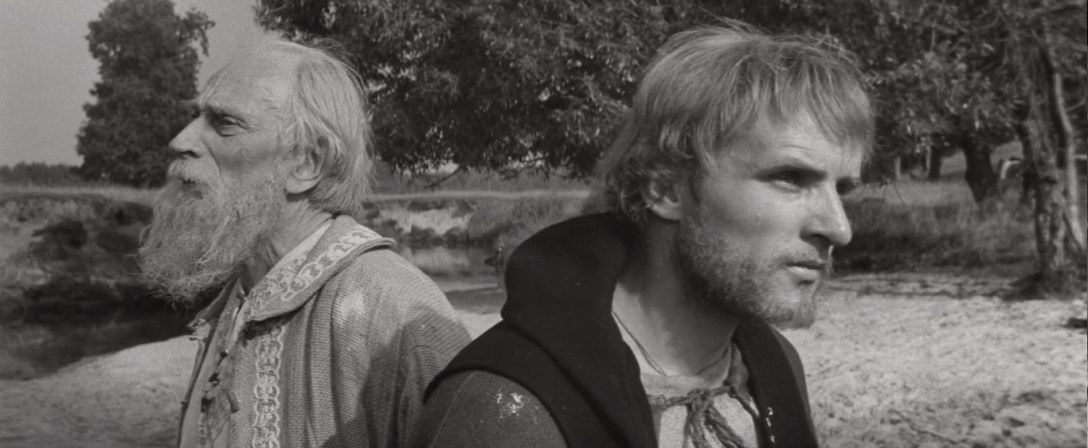
Directed by Andrei Tarkovsky. Written by Andrey Konchalovskiy and Andrei Tarkovsky
Another work of cinematic alchemy, Andrei Tarkovsky’s Andrei Rublev is a three-hour epic about the 15th century painter by the same name, a portrait of Russia during his time, and a crystalline presentation of mankind in all its glory and disgrace.
It follows Rublev up through the years, but keeps its eyes on those around him, like local jesters, who entertain townspeople despite being outlawed by the ruling class, marauding Tartars who pillage the Russian countryside, warring royal brothers, and laborers who toil in the filth to build something everlasting.
Divided into time-bound chapters, it’s a story of a nation in upheaval, religion’s place within it, and an artist’s struggle with his purpose. By weaving through bloodshed, trauma, suffering, and a few tender moments, Tarkovsky explores how the artist takes in the world and gives back to it.
A three-hour movie with no clear throughline can be intimidating to consider, and the way Tarkovsky breaks it into pieces means the movie’s build-up isn’t immediately obvious. Sequences revolve around situations involving others rather than Rublev, but it’s a way for Tarkovsky to show how he masters both the epic and the intimate, and evokes one in the other and vice-versa.
Burning cities and community-gathering spectacles tell of consequential moments on a grand scale, and with stunning agility and elegance, he can tighten his focus on the experience of an individual and make a character stand in for an entire group of people, their actions suddenly glowing with broader significance. When Tarkovsky then finally finds his way to focusing on his central character, this sensation of collective representation is overpowering.
Andrei Rublev has the potential to touch something deep within you with its spiritual messaging, but it’s equally a movie to be felt in a literal sense. You can feel the wet mud trap farmers and villagers as they toil, you feel the rolling grain brushed by the wind as farmers tend to their crops. In winter, when food’s low, you can feel icy air choke your lungs. After a village is raided and its people slaughtered, the debris, of severed flesh, furniture, and structures, clutters the screen to a point where there’s not a single inch of exposed floor. No suggestive imagery, no fade to black and invitation for our imagination to fill it in. No, it’s painted vividly with a terrible grace. Tarkovsky makes you live it.
So much of Andrei Tarkovsky is devoted to what we do when faced with great hardship. People mull over life’s big questions; they’re humiliated; they doubt themselves and turn on their friends. There’s so much shit in our world, Tarkovsky seems to say, but redemption can be found in resilience and faith. That’s still words to live by, even if that faith isn’t directed heaven-bound or offered to a deity we know the name of.
 Mikkel Frederiksen