Directed by Edward Berger. Written by Peter Straughan
More than a billion people the world over look to one man as the shepherd of their faith, and every once in a while, a few hundred men, all rife with ambition, covetousness, and deceit, gather to elect one among them to become this shepherd. I’m talking of the papacy and the collection of cutthroats known as the College of Cardinals, the papal electors.
Their chief task, its circus and calculated chaos, is brought to stunning life in Edward Berger’s Conclave wherein a pope passes, and cardinals from all over the world descend on Rome to elect his successor. They say when a U.S. senator looks in the mirror, they see a president. The same can be said of cardinals.
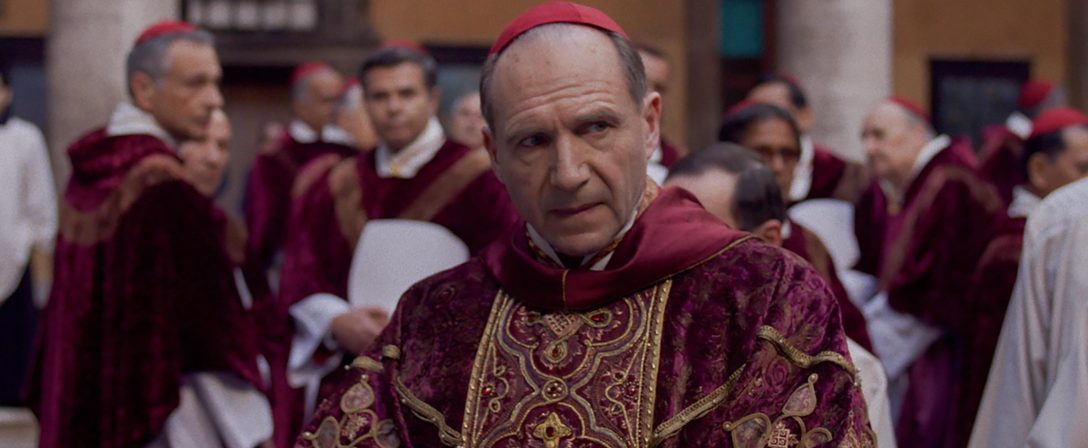
As the unenthusiastic master of ceremonies stands Ralph Fiennes as Lawrence, Dean of the College, and surrounding him are Bellini (Stanley Tucci), Trembley (John Lithgow), Adeyemi (Lucian Msamati) and Tedesco (Sergio Castellitto), favorites for the pontificate, each one as scheming as the next. Reformers, liberals, and old testament rulers, all unsheathing their knives. Let the games for the soul of the Roman Catholic Church begin.
Conclave has made a thriller out of a millennia-old ceremony that’s conducted partly in latin, features several ballot votes, and whose participants’ average age streaks past 60. That alone is remarkable. Screenwriter Peter Straughan also wrote Tinker, Tailor, Soldier, Spy, the story of a molehunt within MI6, and here he transposes the cloak-and-dagger antics of spycraft to the Vatican. It’s striking how well it fits, but perhaps not that great a surprise, given both institutions’ predilection for secrecy, factions, and rites.
Similar to how its central process is carried out with such pomp, gravity, and self-awareness, so does Conclave offer a cinematic experience that you don’t come by often these days. It’s graced with forceful writing, monologues with both form and function, exquisite bits of composition and lighting that hasn’t forgotten cinema is a visual medium and that it’s okay to be bold in your expression.
It’s clear the craftsmen behind Conclave believe movies can be memorable for more than how they make you feel, so they offer moment after moment of scenes that burn themselves right into your retina. All of this intrigue and tension is carried along by Volker Bertelmann’s orchestral score, a hectic yet graceful, effusive yet mysterious soundscape that feels as if it’s in the room with the cardinals at times, it’s that intense and imposing.
Taken altogether, Berger’s movie is stunning and you can only describe Conclave as cinematic, something that belongs on the big screen because it deserves all that room. It rejects being reduced to in-flight entertainment, hung on the back of someone’s seat while jet engines drone over it; it won’t diminish itself to be watched on your laptop’s smudgy screen with its built-in speakers choking out the sound. You don’t get a sports car to sit in traffic.
A heavyweight cast led by Fiennes shine, bringing to life these duplicitous holy men. The sanctified air that’s quickly revealed to be sanctimonious before it turns acrimonious. Jesus would weep to behold such a group of men claim to be God’s stewards, but it’s a thrill for everyone in the audience.
In the middle of the menagerie, Fiennes is also an emotional anchor as a man doubting his faith, who asked to leave the church, and was denied, shortly before this dubious honor was thrust upon him. Fiennes ability for soft-spoken sensitivity and thundering outrage comes to the fore here, perfect for man looking for his faith in a hopeless place.
Conclave is proof men talking in a room can be spectacular when the writing, direction, and artistic force behind it makes it so. It steeps itself in the occasion, then matches it with its own filmmaking in this story of court intrigue that has conniving operators, anguished revelations, and stunning twists right up until the very end. All fire until the white smokes plumes.
 Mikkel Frederiksen