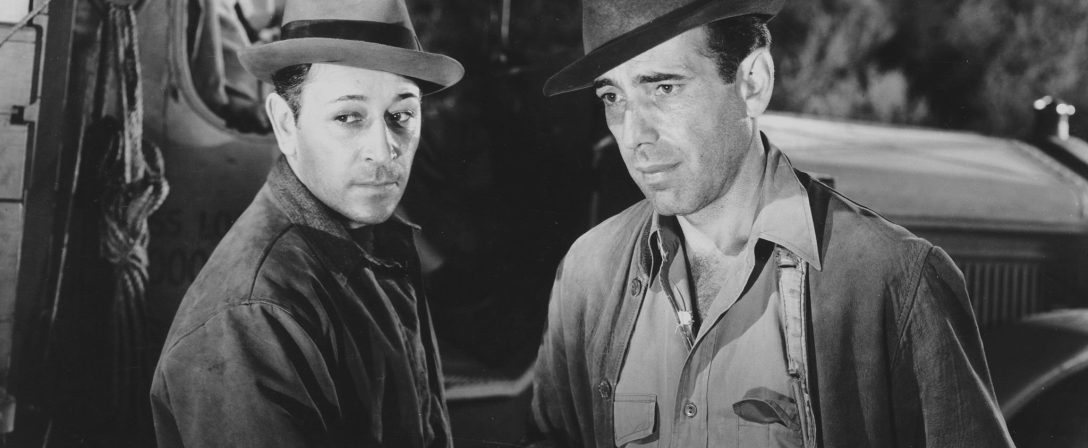
Directed by Raoul Walsh. Written by Jerry Wald and Richard Macaulay
Raoul Walsh’s They Drive By Night is a blue-collar manifesto before it becomes a thriller, with each half held aloft by George Raft as trucker Joe Fabrini and Ida Lupino as Lana Carlsen, a trucking magnate’s wife who grows obsessed with Joe.
Walsh’s bleak working class struggle ends in delirium, but it starts with worker solidarity. Joe’s pulling long hours on America’s highways alongside his brother Paul (Humphrey Bogart, more subdued and sensitive than you might expect from him) and it’s a precarious way to make a living. Financing his own truck, he’s an independent contractor trying to avoid the loan shark coming to collect, and trying to claw back what he’s owed from the shipping agent he’s delivering for.
Truckers along the road know each other, help each other, support each other, all because they’re all too familiar with the antics of business owners. Even when they’re all competing for the same limited number of jobs, they’re not fooled. Class consciousness is not lost on the dusty highways.
The insidious mechanics of capitalism are caught in Walsh’s headlights too. The loan shark hides behind laws and the police to enforce the terms of his predatory lending, constantly justifying himself (“I’m well within my rights!”) and business owners exploiting workers because of their monopoly on jobs. They’ll tell you they don’t have cash to pay you as they count out $100-bills in front of you. They Drive By Night is an aggressive takedown of capital’s lawful facade.
George Raft is a spark plug as Joe. Raft brings an intrepid physicality to the role and retains a gleam in his eyes despite the backbreaking labor that is his profession. Joe comes off as resourceful and shrewd, but never a cutthroat. He’s a romanticized ideal of the upstart who wants to win according to his staunch morals, and wants to win with his friends coming along for the ride.
Paul isn’t like that. The grueling schedule of hauling cargo up, down, and crisscross the American southwest is wearing on him, and Bogart moves as if he’s clutching himself the entire time. Anyone whose idea of Bogart is rooted in his tough-as-nails image earned from detective stories will find him vulnerable and self-effacive here, because his star-making turns are yet to come.
Both men’s resolve is tested by the amicability of Ed Carlsen (Alan Hale), a former trucker like them who now has his own company and is succeeding like crazy. He’s the blueprint for Joe, and with his blue collar background not forgotten, Ed’s a business owner unlike any other. One who’d love to have Joe work for him, and despite Joe gently rebuffing him, readily supports Joe in his own trucking dreams.
His wife Lana likes Joe for other reasons, and tries even harder to get him. A fun element of movies from this period is how rich people dress rich at all times. Lupino’s wardrobe is a spectacle of its own, often dressed like an astronaut or something completely alien to the working class environment that puts the clothes on her back. It’s interesting for the costume design alone.
Lupino is the livewire of They Drive By Night and her increasingly desperate attempts to claim Joe are not only what gives Walsh’s movie its energy, it’s also additional commentary on the impossibility of the American dream. Lana pulls strings to enable Joe’s success, showing us how bootstrapping your way to riches is really down to lucky breaks or well-positioned friends. Joe, despite his industriousness and talent, is not immune to that.
This class consciousness illuminates They Drive By Night from within even as it becomes a frenzied ordeal thanks to Lupino’s hellcat act. Tiny and frail-looking among the grizzled men, Lupino makes herself a switchblade, unpredictable and dangerous, and her deadly desire adds a pulpy but thrilling crescendo to Walsh’s succinct and considered movie about bonehard and precarious working class realities.
 Mikkel Frederiksen