Written and directed by Rainer Werner Fassbinder
Ariane and Gerhard are wealthy, important, and married. They pack their bags, one heading to Oslo, the other Milan, carrying on conversation with their backs turned. They leave with curt goodbyes, least of all to their crippled daughter, Angela, a teen whose resentment of them both is clear as daylight.
Husband and wife aren’t going where they say they’re going. They’re both meeting their longtime lovers, and, unbeknownst to the other, they’re taking their side pieces to the same location, the family castle. Angela somehow knows this too: she’s going to make the trip up with her mute governess and start some shit.
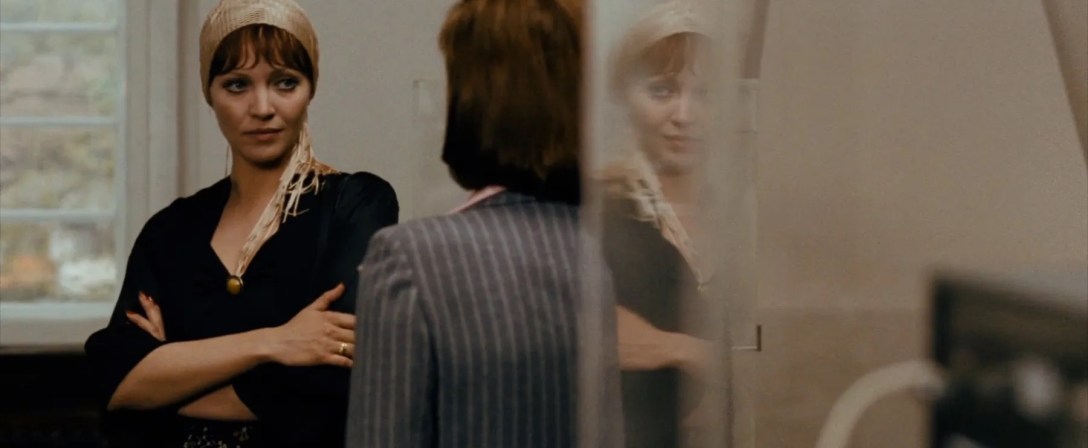
Chinese Roulette, Rainer Werner Fassbinder’s perverse parlor game where a family’s dirty laundry is used to strangle all involved, is a dirty, insolent little thing that barely hides the contempt it has for everyone it trots out on screen to scorn: the über-wealthy married couple, their vacuous lovers, and the conniving servants.
It’s almost a diatribe. Ariane and Gerhard, caricatures of callous and aloof elites, void of shame, can only be provoked by their daughter whose own mean streak they know is their doing. They’re ultimately not all that interesting, too thin in their dull, almost utilitarian flaws. The uncouth touch works for the supporting cast, the dramatic cattle prods that they are, like Brigitte Mara as Kast, the housekeeper, a lecherous horn beetle both hilarious and off-putting in how she licks her teeth and feels herself up in self-satisfaction.
Chinese Roulette culminates in a homemade parlor game by the same name, which almost takes up a third of the movie’s runtime. A person guessing game among the people present, it’s a game of barbs and a summation of this story of familial dysfunction. It’s a mischievous premise and a bit of writing that could be ingenious had its characters been a tad deeper so as for the outcome to not be so obvious. The movie’s eponymous game becomes representative: clever ploys let down by the subject and characters involved, losing steam because there’s not enough fuel to sustain it.
Technically, Fassbinder is incredibly playful here. He choreographs his actors to move about within his takes, arranging themselves again and again while his lens travels back and forth, swirls, jumps, and pulls in for exquisite arrangements. It’s flamboyant, extravagant, and indulgent, and a distinct pleasure to watch simply for the sake of it. Chinese Roulette sparkles high above our current surfeit of bland filmmaking cowering behind the verisimilitude of feeling “natural”.
Even if the movie, with its rather loathsome characters and flat premise makes this a lesser experience than some of Fassbinder’s other works, it’s still a sparkling exhibition of how good he is with a camera in his hands. Sequencing, blocking, composition, he does all this within the confines of a single room with sparse furnishings, essentially putting on a show in a phone booth with just his hands for props. Technique dripping from every pore.
So it’s stylish, but vapid. Chinese Roulette powers ahead under the confidence and ability of its director, and while its actors can titillate, tease, and cause affront with what they’re given, the malfeasance isn’t enough, and Fassbinder’s film is easy to let go of.
 Mikkel Frederiksen