Directed by Matthew Rankin. Written by Ila Firouzabadi, Pirouz Nemati, and Matthew Rankin
The Winnipeg of Matthew Rankin’s dazzling Universal Language sadly doesn’t exist, but it does suffer from the same anonymity obscuring its real life inspiration, as other Canadians in Rankin’s movie have a hard time remembering the province it is the capital of, forgoing Manitoba to instead stumble onto Alberta, its neighbor from two doors down.
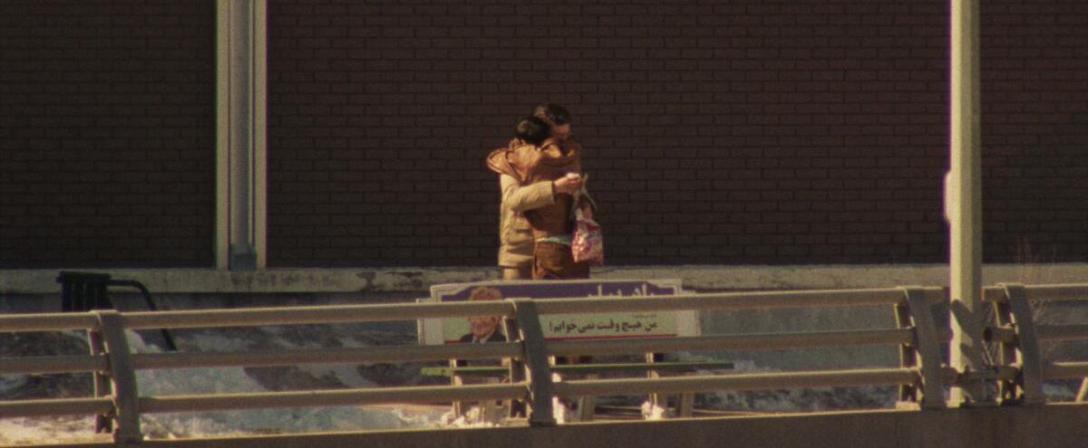
This is actually a gift, offering Rankin and writers Firouzabadi and Nemati the chance to remake Winnipeg, steering it off into a magical in-between space where the official language is Persian (we’re still in Canada, so some kids go to French immersion schools) and the days glow with golden hour sunlight where brutalist architecture jutting out of the snow cuts beautiful shapes with its stark geometry.
For Matthew, our protagonist, it’s not a forgotten place, but one dearly missed. He’s heading back from Montreal, many years after leaving, coming home to visit his mother whom he’s shocked to find is no longer living in his childhood home but staying with strangers, her mind gradually slipping away from reality, from him, from the life they shared.
Here, the frostbitten streets are lined with stalls selling typewriters and tea, butchers sing poems to their turkeys, the city’s florist tells you to not yell within earshot of the flowers, and a local tour guide treats you to the sights of an abandoned suitcase no one has dared move and speaks of the great parallel parking incident of 1958.
Rankin’s Winnipeg is entirely its own. So is Universal Language.
It performs the rare magic trick of pulling us from reality so that we’re open to its cinematic language. A modern day society we know to be harsh and cold can become tender and warm, its ugly suspicions transformed into kind compassion. In many ways, what separates a stranger and family is a “hello”.
If the open arms of Universal Language wasn’t enough, its whimsical sense of humour is truly disarming. You’ll laugh when a schoolboy, grinning from ear to ear, announces he’s dressed as Groucho Marx to the consternation of his teacher; you’ll laugh when the Tim Horton’s sign lights up in Farsi; you’ll laugh when Matthew’s boss, a Quebec bureaucrat, says he must speak positively of his former employer, and if not that, then neutrally is acceptable as well.
You’ll spend an hour amused at the frolicking inventiveness of Universal Language before the movie shows you what’s in its heart and becomes a moving depiction of not only humanity at its most hospitable and philanthropic, but also of the guilt and loneliness many people face in an increasingly international world where the necessity of economic migration has increased. The longing, the doubts, the confusing alienation you feel from your home, and the realization of the transformation you’ve undergone without knowing.
All of this, the laughter, the poignancy, the novelty, and surprising beauty hides within Universal Language, a rare gem whose alchemy needs to be seen – not to be understood, but to be felt, like the knowing look from a stranger in public that reminds you that for all our differences, nuances, and distinctions, some things are universal, and they’re the important ones.
 Mikkel Frederiksen