Directed by Peter Weir. Written by Jeff Green
A sunny day in the country has never felt so ominous as it does in Peter Weir’s Picnic At Hanging Rock, the story of four schoolgirls who go missing in the crags of a pile of volcanic rocks, and the men who are reduced to rubble in search of them.
Dense with mystery, Picnic is not a typical example of the genre. Often told over the shoulders of those meant to solve it, they’re meant to thrill, and that comes with a certain pace. They can feel dogged, rigid, hustling along even if what they’re searching for is in the wind. Picnic leans into it and becomes like the wind, airy and hard to trap.
It lets itself breathe from the very start, a teasing bit of pan flute dancing over a foreboding organ drone. We listen, and watch girls immersed in their rituals on Valentine’s Day, 1900: reading love notes, ornate, pretty things, these letters, and preparing themselves for the day’s outing. Cleaning their faces in a wash basin filled with flowers, tightening each other’s corsets like one organism, with some understood, but undefined look passing between them. Forget the year, we’re alienated on an existential level.
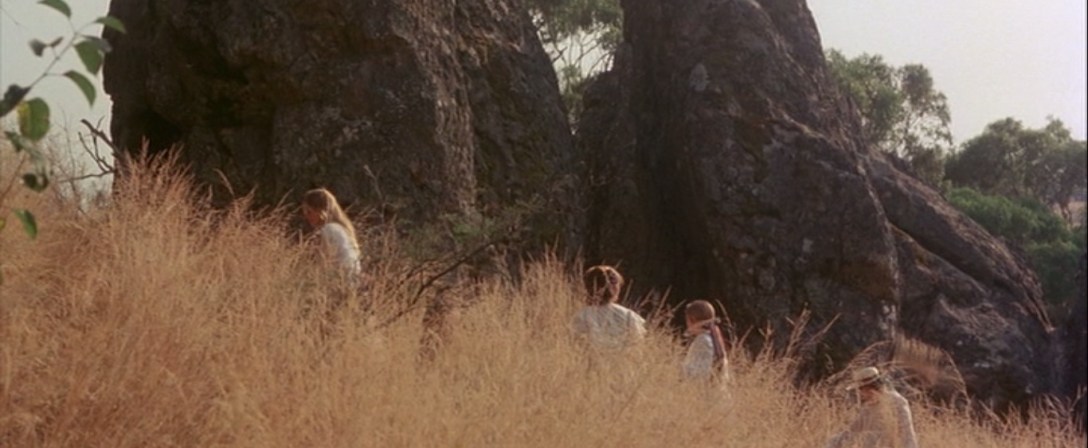
Once out on the picnic, out in the unforgiving Australian bush, Weir looks up. The black, harsh shape of Hanging Rock looms above us in a shot Weir returns to often, and in the lush green at the rock’s base, the girls lounge around until four peel off, one looking back and waving farewell in a way that feels significant, and yet you don’t know why. Again, we fail to connect to their internal wavelength. As they walk off, and the sun sets, and they go missing, Weir doesn’t mean to let us in.
Like the policemen and villagers who are stumped as to what happened to these girls, Picnic hangs someplace above you while you struggle to get to it. The mystery is impenetrable, but the movie has this airiness to it, opening it up to suggest something greater and beyond your reach.
Despite the wonder, it remains satisfying because it’s clear Picnic isn’t obtuse on purpose, dense with its themes of feminist liberation and sexuality, as well as contemporary society’s failure to comprehend this new wave of girls becoming women. The absence is the feature.
The dissolution of imposed femininity gives Picnic the air of myth, but the tangible circumstances and the fallout of the fateful excursion has the acute sting of tragedy. A slowdown around the middle, where it Weir and writer Green tries to keep the intrigue while in the company of bemused men, doesn’t detract from the overall impression of Picnic At Hanging Rock as a movie with vision, the guts to pursue it, and a willingness to let its audience dig through the crags and find meaning for themselves.
 Mikkel Frederiksen