Directed by John Bailey. Written by Roy Carlson
Usually, an erotic thriller is pronounced dead at the scene when its two leads have no chemistry but John Bailey’s China Moon overcomes this fatal flaw with the handiwork surrounding it, as Ed Harris steps out of character as a consummate pro of a policeman whose heart goes ka-thunk for a mysterious, doe-eyed woman.
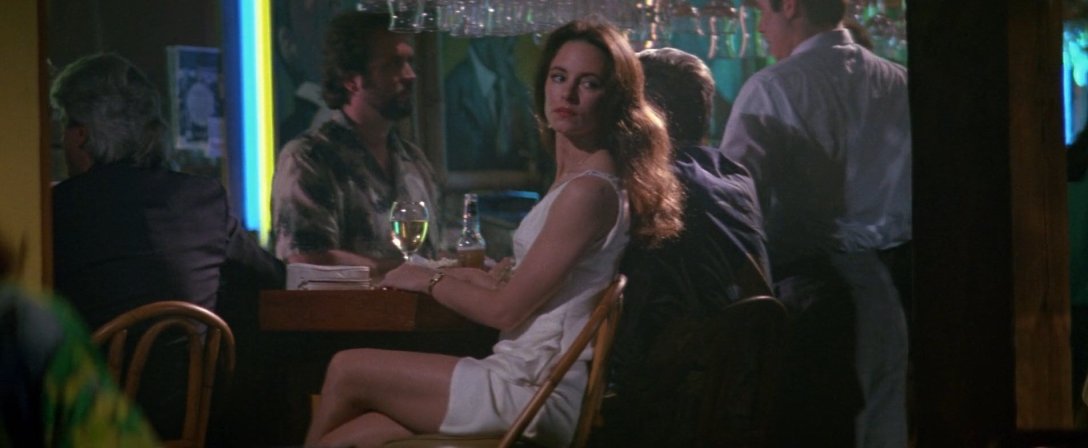
Harris plays Kyle Bodine, small-town homicide detective. Damn good at it. He has the meticulousness of an accountant, the focus of a buddhist monk, the drive of a prey animal. It therefore seems very out of character when the composed facade slips right off his face as he comes across Rachel, moody and pensive, but most importantly beautiful, staring into her drink at a bar.
She has an abusive husband at home (Charles Dance, deep southern drawl, cruel and demeaning) and resists Kyle’s off-putting style of courtship (using his position to attain private information, stalking, his badge essentially a crowbar) but relents, and into love they fall. Then something happens that’ll test Kyle’s devotion to the law and to Rachel.
I’ll buy Ed Harris playing murder police any day. I’ll even buy Ed Harris, the actor, being good murder police by virtue of the persona he’s cultivated on screen for decades. He doesn’t enjoy my goodwill as a romantic lead, however, and together with Madeleine Stowe as Rachel, I can’t quite come around to those two letting passion for each other trump sense.
To watch Harris’s face tear itself into a buffoonish smile does melt your heart a little, the emotion strange and overwhelming, but this unconvincing central love affair is a problem of course. It means China Moon has to be great at a lot of other things for the entire thing to not fall flat. Fortunately, it can provide for its shortcomings.
John Bailey’s resume as a director is modest but his work as a cinematographer speaks for itself: In The Line of Fire, Groundhog Day, American Gigolo, As Good As It Gets, Cat People as well as Ordinary People, The Big Chill. While Willy Kurant serves as the cinematographer on China Moon, Bailey’s clearly not forgotten how to shoot a scene by moving to the director’s chair from the camera operator stool; the movie looks gorgeous.
Atmospheric lighting, framing, and blocking that shows actual care for where things go – it’s a wonder how an otherwise inconspicuous thriller from the mid-90s can show up 95 percent of what’s released today.
Bailey also indulges small storytelling details and provides both style and substance. The movie begins with a sleek opening scene where a private eye stakes out an extramarital affair, sneaking up under the cover of a howling central air-conditioning unit, to gently pry open the blinds to snap some shots of the steamy action. Later, at a bayou-adjacent bar, Bailey lets a blues band’s heady song set the stage instead of relegating it to background music.
There’s a real awareness of how meticulous assembly pays dividends in the shape of these world-building intangibles and the end product is a seedy, dangerous vibe to China Moon that is crystal-clear from the start.
Hiding in the wings is Benicio Del Toro as Bodine’s greenhorn partner Lamar Dickey who proves himself surprisingly astute as the movie goes on, and his transformation is one of China Moon’s secret weapons, an early look at actor who’d go on to be widely celebrated and already showing us why here.
China Moon keeps you guessing as it unfolds, and that’s any murder mystery’s job number one, and taken together, its thriller elements can compete with a classic like Body Heat, another bout of passion-driven mischief in Florida. What keeps it from going over the top and landing among the truly great is the sizzle, the rush of blood, the allure – the very thing that convinces us we might not have done anything different if faced with the same temptation.
 Mikkel Frederiksen