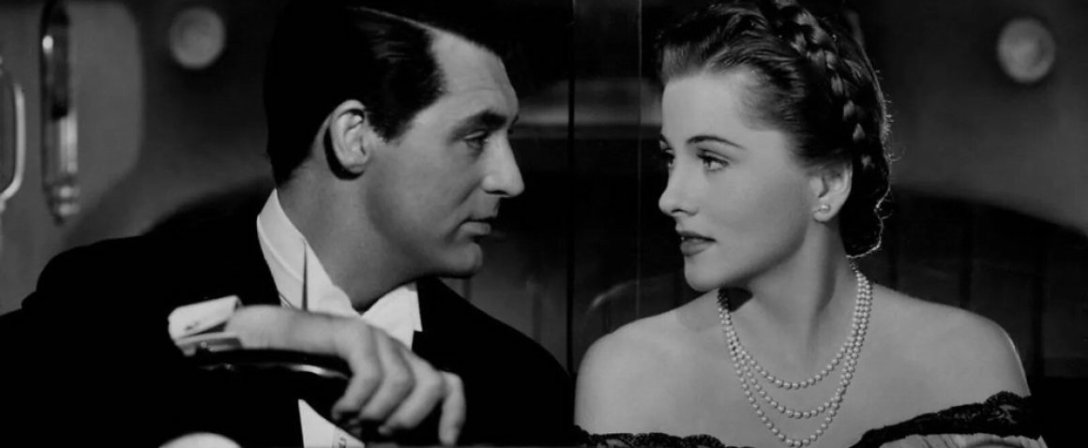
Directed by Alfred Hitchcock. Written by Samson Raphaelson, Joan Harrison and Alma Reville
How do you love someone you believe is capable of the worst? How do you love someone whose pet name for you is monkey face? How do you love someone you barely know?
Fascinating questions all, and here to try and answer is Joan Fontaine as Lina, a mousy (by Hollywood standards) but wealthy woman who’s swept off her feet by a handsome rogue but soon begins to think he might kill her to settle his debts.
Lina wears glasses when she reads, and she likes to read a lot, so she’s not considered the belle of the ball in upper class England where Alfred Hitchcock’s Suspicion takes place. Cary Grant is Johnnie, a gatecrashing cad who nonetheless has women flocking around him to the consternation of their fathers, monocle dropping into their brandy glasses at his brash intrusion into their time-honored social circles.
Johnnie takes a shine to Lina, and with a wooing style that’ll make dating apps look like a safe haven, he still wins her over, Lina’s fear of spinsterhood perhaps adding leverage. An elopement and short honeymoon later, Lina begins to know some things she’d rather not about her hubby: how he doesn’t have any income, how taking out loans is his preferred job, and how he loves betting on the races. Something’s got to give.
You’ll have to not be paying attention to find the romance between Johnnie and Lina believable, but once Suspicion gets past this little (big) rough patch, there are a few things to look out for.
One is the obvious pleasure of Cary Grant as an insufferable charlatan, smiling like a fox, a lie behind every molar. He’s rude, impatient, insistent, a borderline pest, and anyone who’s mostly familiar with Grant as the image of suave grace and integrity can have fun watching him ferret his way around.
Another is the scaffolding, trap door, and noose Hitchcock builds for you as you watch Lina grow increasingly suspicious of her man and try to pick apart his lies to suss out his true intentions. Hitchcock never quite lets you get comfortable, turning the tables around and around and you along with it, all the while steadily building the tension between Lina and Johnnie until the steam starts whistling.
Nine years later Joan Fontaine will play a hellcat in Born To Be Bad and planting Suspicion as a point of reference provides a testament to Fontaine’s incredible range. As Lina, Fontaine lets an immense vulnerability simmer beneath the doubts, portraying a woman hopelessly in love against her better judgment. You can watch Lina’s feelings for Johnnie undulate in real-time, Fontaine’s face melting and fracturing seamlessly. She deservingly won an Oscar for her work here.
Fontaine and Grant deliver standout performances individually, but have little chemistry together, which keeps Suspicion from truly catching fire, but the suspense, the wicked pleasure of Grant, and Fontaine’s depth is enough to provide a provocative, evocative, and tense movie about what purpose lies can be put to.
 Mikkel Frederiksen