Written and directed by Bong Joon Ho
In the vein of his other English-language movies, Bong Joon Ho’s back to lampoon capitalism, colonization, the current political landscape, and society at large; once again, it’s an uneven affair where the best idea doesn’t win out and we must settle for the obvious less.
In the not too distant future where social accountability has been restored, the soulless egomaniacs who were rejected on earth will set out to colonize foreign worlds to build their racist utopias. Societies are often built on the toil and suffering by the less fortunate, and no one fits the bill better than Mickey Barnes (Robert Pattinson), a gormless never-do-well who’s in deep with a loan shark.
Enlisting as an “expendable” nets him a ticket off Earth, but he ought to have read the contract, because it means he’ll be a human lab rat subjected to dangerous labor or medical research, dying often and awfully, only to be 3D-printed anew the next day with all his memories intact and ready for more.
We catch up with him as Mickey 17, meaning he’s on his 17th life, as the colonizers reach their new home planet. Someone’s already there: a species of bug-buffalo looking creatures that could be considered cute once you look past their off-putting textures of slime, hair, scales, and tentacle-y tongues.
The colonizers, led by Mark Ruffalo’s demagogue Kenneth Marshall, want their new home to be rid of the indigenous species, and so Mickey becomes caught in the middle of a standoff where he’s way out of his depth. What’s worse, due to an erroneously assumed demise, a Mickey 18 has been printed, only this Mickey is a hellraiser who has no interest in being anyone’s whipping boy. Amidst the interspecies conflict, a mutiny’s brewing aboard the colonizer ship.
Mickey 17 is another bit of dystopian science fiction satire from Bong Joon Ho that’s very lopsided. Most of the movie is worldbuilding and establishing the premise, after which the entire thing plays out in the final third. The gradual rise is actually fun before we get to the plummet, but the emphasis also shifts to something less interesting: a predictable bit of political messaging that steals the stoplight from a more interesting philosophical exploration of identity.
Mickey 17 and 18 couldn’t be more different, and as Mickey’s girlfriend Nasha (Naomi Ackie) tells him, some of the other Mickeys also exhibited outlier personalities. How could this be? Isn’t every Mickey an exact replica of the original – mannerisms, desires, fears, quirks, and all? There’s a compelling bit of existential spelunking happening here, but as the plot ties itself to a rote colonialist critique, we’re dragged away like a child window shopping at a toy store.
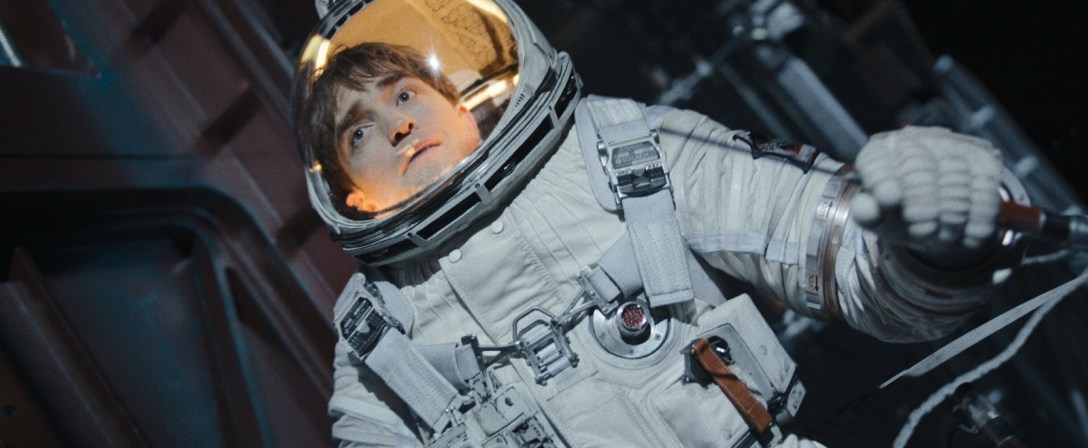
Actually a child in a toy store: Robert Pattinson. As the many Mickeys, he does double-triple-quadruple duty as the poor soul, and he’s clearly having a lot of fun as a bit of a nitwit who has long suffered the consequences of being a tagalong, and then bending this character out of shape. Pattinson makes Mickey’s voice a reedy nasal instrument, and hunches his body, turning Mickey into the embodiment of someone who’s never stood up for themselves. But as they say, the meek shall inherit the Earth, or in this case, some other planet.
As failed congressman turned cult leader Kenneth Marshall, Mark Ruffalo does an impression of everyone’s least favorite politician and throws in some televangelist jitters and it’s not a good look. Satire should at least feel unburdened, but it’s clear how hard Ruffalo’s working up there and it looks like community theatre. In a movie that almost doesn’t feel like it needs a villain, it’s unfortunate it’s saddled with this one.
That’s because the character Ruffalo portrays and the level of satire he heaps on there along with Toni Collette as his zooted out bible belt wife still doesn’t compete with reality. There are real elected leaders out there right now, walking around flapping their lips and stealing oxygen who do weirder, crueller, more small-minded and pathetically vain things than Marshall, so Bong’s already flat style of satire is a mile behind from the get-go.
Bong’s now up against the same predicament satire site The Onion is where their work has to be provocative, even outrageous, but still within the realm of possibilities. Reality isn’t burdened by those limits, and truth, as Mark Twain said, really is stranger than fiction. These days it’s meaner and dumber too.
There are great bits in Mickey 17, like the question of identity it dips its toes into, and Robert Pattinson, who proves himself once again a mercurial star who can turn his hand to anything. These bits unfortunately stand out all the more because they’re in contrast to the tired clichés that govern much of Bong’s movie, and lead it into that area of obscurity that is the destiny of middling films.
 Mikkel Frederiksen
[…] can sometimes hurt a movie when their lampooning doesn’t compete with reality (Mickey 17 suffers that fate) but the curious fact of how Guest and co-writer Levy’s vision stacks up now […]
LikeLike